
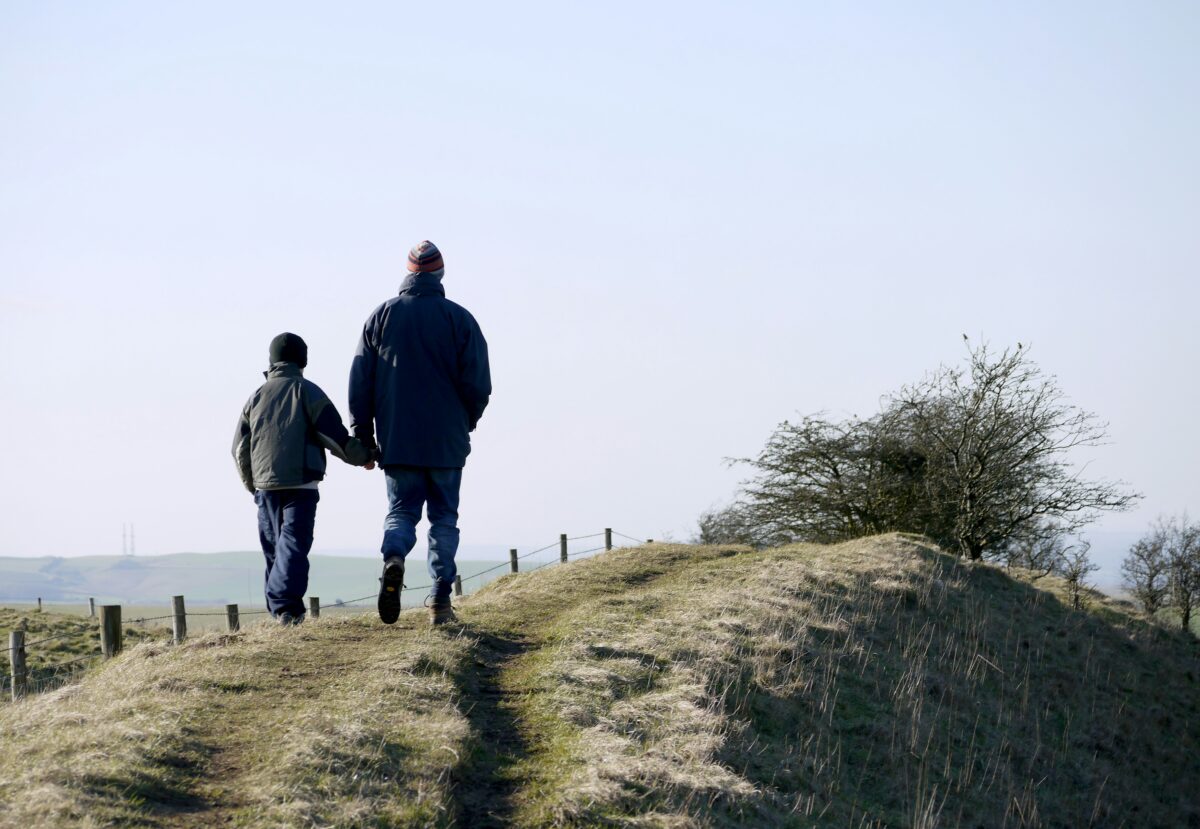
“What’s wrong with pear trees?” I ask, wondering if my dad is getting senile.
“Well, they’re an invasive species. They’re not allowed to sell them in nurseries here anymore. They’re very spreadable because of their seeds. The ones in this subdivision are cultivated so they don’t have the thorns, but once the birds start getting to them, and they, you know, do what birds do, the ones that turn up in the wild have the thorns and then they take over everything around them. It’s the monoculture. If you plant only one kind of tree, the next emerald ash borer comes along and now your entire neighborhood is wiped out. On the tree council we’re recommending putting in at least three different types in a planting now. See, look at this, Tristin Trail is all maples now. Don’t need any more maples here, it’s silly.”
I nod. Think about the meatballs my brother Chris was cooking when we left the house. Dad’s on his last walk of the year to hit his goal. He walks a mile for every day of the year. He passed 365 the first week of December, but since there’s no snow on the ground, he’s going to make 400 with me here today.
It would be the perfect time to ask him. We’re lost in a byzantine maze of identical houses in a neighborhood that used to be a farm just four years ago. It’s a sub-urb with no urb. I don’t understand why people want to live like this. I get the same feeling every time I go out to buy things, every time I’m using some new app on my phone, so I can save fifteen cents on carrots. We pass another house, this one occupied, a flag with a thin blue line, the uniformity fades, which makes me feel better.
“They live here year-round now, did you know that?”
“Who?” I ask.
“The geese, it’s so warm they don’t fly south anymore.”
I notice a giant gang of them bunched near the subdivision’s fake lake.
“They just said we’re already home, huh?” Deep breath. “Dad?”
He stops and looks at me, puzzled.
“I’ve been meaning to ask you, uh . . . nevermind. Your, uh, shoelace is untied.”
He stops and bends. He is more flexible than me, even though thirty years older. I don’t want to live to seventy-six. I want to lie down in a box and shut the door like a vampire. I want them to turn the heat up high when they cremate me. I want the ducks to eat my eyeballs. I want the geese to shit my brain.
“Look at this, it’s original. I don’t think they make silos out of cement anymore.”
He’s slapping it. If you curate your vision carefully it can still look like an Indiana farmhouse scene, with the cement silos, and the geese that don’t fly south anymore, and the fake lake in the background.
Coming back to the main road, we pass a house with all their inflatables flattened low to the ground; the valley of the fallen, where Rudolph and Santa and the elves lie prostrate. The house next door has a quilt on it. That’s homey. Then I see another quilt on the side of the house. It has a design that looks like a swastika on it.
“Yikes” I say out loud.
“Oh, that’s a Spirit of ‘76 pattern.”
“Uh-huh”
“Not the one I would of gone with,” he says and shrugs.
“Dad?”
His hazel eyes flash expectantly toward me.
“I . . . uh . . . I wonder if, you know, you’d ever think of moving closer to Nicole and me?”
“Oh no, I’ve got everything I need right here.”
“Sure, sure, it’s just what if something happened and we couldn’t be there?”
“I’ve got neighbors. It’s not like the city, we don’t shoot our wounded. There’s Ellen on my left, and then Rusty and Jane, Rusty and Jane’s boy, what’s his name, Andrew, I think . . . is back in town for Christmas. You should meet.”
“I know it’s hard for you since Mom passed.”
“He’ll be at the service on Christmas Eve.”
I nod.
“That’s 400,” he says. “Thanks for coming with me.”
There are hospitals nearby he can go to, across the river. It’s selfish of me to want him closer, to take him away from his home.
“We should be getting back to the house before Bev starts to worry.” Bev is my sister-in-law. She is not worried. She is grateful for a break. She is trying to work from Dad’s desk, but it’s not happening with him popping in every two minutes to tell her his latest theories on monoculture and the church fundraising campaign.
“Did I tell you about the NAACP?” he asks.
“The what?”
“They sent me! They sent me to a meeting as their representative. I told him, I says, you know, I’m not black, you know that, right? And they say, ya Jack, we know, we just need you to go and be our eyes and ears, just take some notes at the council meeting. So, I went. They about fell out of their chairs when I put on my little name card from the NAACP.”
“I bet.”
“Anyways, everyone sneaking looks kept me from falling asleep.”
He likes to complain about these meetings he volunteers for. He must be on seventeen different committees around town, United Way, you name it. I think twice as many now since mom passed.
There’s 300 feet left before I’m out of time. We’ve stepped in more mud than we realized walking near the duck pond.
“Dad.”
He stops thirty seconds later, once he realizes I’ve stopped.
“Why didn’t you tell me?” I ask, while scraping off mud.
“Tell you what?” he asks, a little too sharply.
“You know.”
“You’re acting strange,” he says. “Have you been taking your medications?”
“Yes.”
“That’s good,” he says and walks on toward the house. He goes to the mailbox. Shakes his head at the bills and junk mail. “Look, we got a Christmas card from the Judds.”
“The Judds are still alive?”
“How old do you think they are?
“Why didn’t you—”
“I always wanted to. Your mother never wanted to tell you.”
It was my mother that told me, so I know this is a lie. He looks up suddenly. “I love it when they do that.” A hundred birds fly off a wire. “Ever wonder how come they don’t run into each other?”
I scrape imaginary mud.
“You were a fragile boy.”
“What?”
“She was worried it would send you off on another episode.”
“I haven’t had an episode in fifteen years.”
“Well that’s what I said. But you hide things from us up there in Chicago. We don’t know what’s really going on with you.”
“Did you think I wouldn’t figure it out? That I didn’t know on some level?”
“I always knew you were a smart boy. I told her that too. How did you figure it out?”
“Mom gave me the papers.”
He waves at a neighbor going by in an SUV.
The silence hangs there for a minute. “What if I wanted to know about my culture?”
“You know about your culture. You’re an American. We raised you as an American and no one can say anything otherwise. It’s a burden to know things you shouldn’t know.”
“Isn’t that my decision?”
“It is now.”
“Yeah.”
“What do you want to know? You want to go learn some folk dances or something? They got lots of Polish in the city. Go ask them, they’ll teach you.”
“Well, maybe I will. If I’d known before I would have.”
“You’re a young man, you got time.”
“Why’d you keep it from me?”
“Well, the lady at the agency in Warsaw, she said—”
“Dad, come on.”
“You’re not gonna go be a victim now, are you?”
As many times as I’ve rehearsed how this might go with my therapist, but I still don’t know what to say. I should have gone to a man.
“You had a good childhood. You had an American childhood. Your mother and I made sure of that.”
I feel like we’re in a TV show now. And I’m the character that I want to slap the shit out of. Do something, fuckface! Now’s your chance, now’s your chance to tell him everything you ever wanted to tell him.
“C’mon, let’s eat. I’m starving” he says.
Then I picture him on the couch with me, reading me the Lord of the Rings and the Chronicles of Narnia, doing all the voices, leaving it where Bilbo Baggins is about to be devoured by a giant spider wrapped in a web, then telling Chris and me Ok time for bed. I picture him putting on his stole with all of the creation stories on it and Noah floating away on the ark, see him throwing the baseball in the yard with me and Chris, then cheering me on while I’m wearing the death gear of the catcher for Y league summer baseball in Texas, the sweat pouring off of me in a nonstop steady stream. Me and him lighting the candelarios outside the church before Christmas Eve cantatas. I see him watching his giant loaves of bread rising. I hear him singing Diana Ross songs in the living room, see him picking me up from the hospital, trying to keep his jaw set and act like I am normal and he is normal, and this is normal, the same jaw set in his face picking me up from the Greyhound station in my long trench coat and cherry red Doc Martens, unshaven and stinking. I smell Caswell Massey number five, see him digging up the flower bed, turning over the soil, holding up a worm to show me. What the fuck do I know about being Polish?
“Me too.” I say entering the screen door he has held open for me.
I too, am starving.





Share this post with your friends.

