
My teacher wife says that one learns by teaching. Of course, a good teacher must have mastery over the material to be taught. Another step of this ‘how-to’ of teaching is in preparing the method of communicating the material to the student(s). Process is a large part of teaching, or any craft for that matter. Better teachers are those whose process is engaging, even compelling, regardless of the challenging part. And a good teacher learns what accomplishes this engagement, what interests the students, how they learn. Unfortunately, the public-school curriculum is now dictated by state ‘standards,’ thus emasculating any initiative and/or creativity on the part of the teacher.
By discussion, regardless of subject area, is really where teaching and learning begins. Participation by all students by verbally discussing with each other ideas is a sort of ‘hands-on’ activity. Students as individuals may have experiences and insights that brings a different perspective to the discussion. A successful teacher learns about divergent views, avenues for related information, and especially how the students understand (or misunderstand) the material.
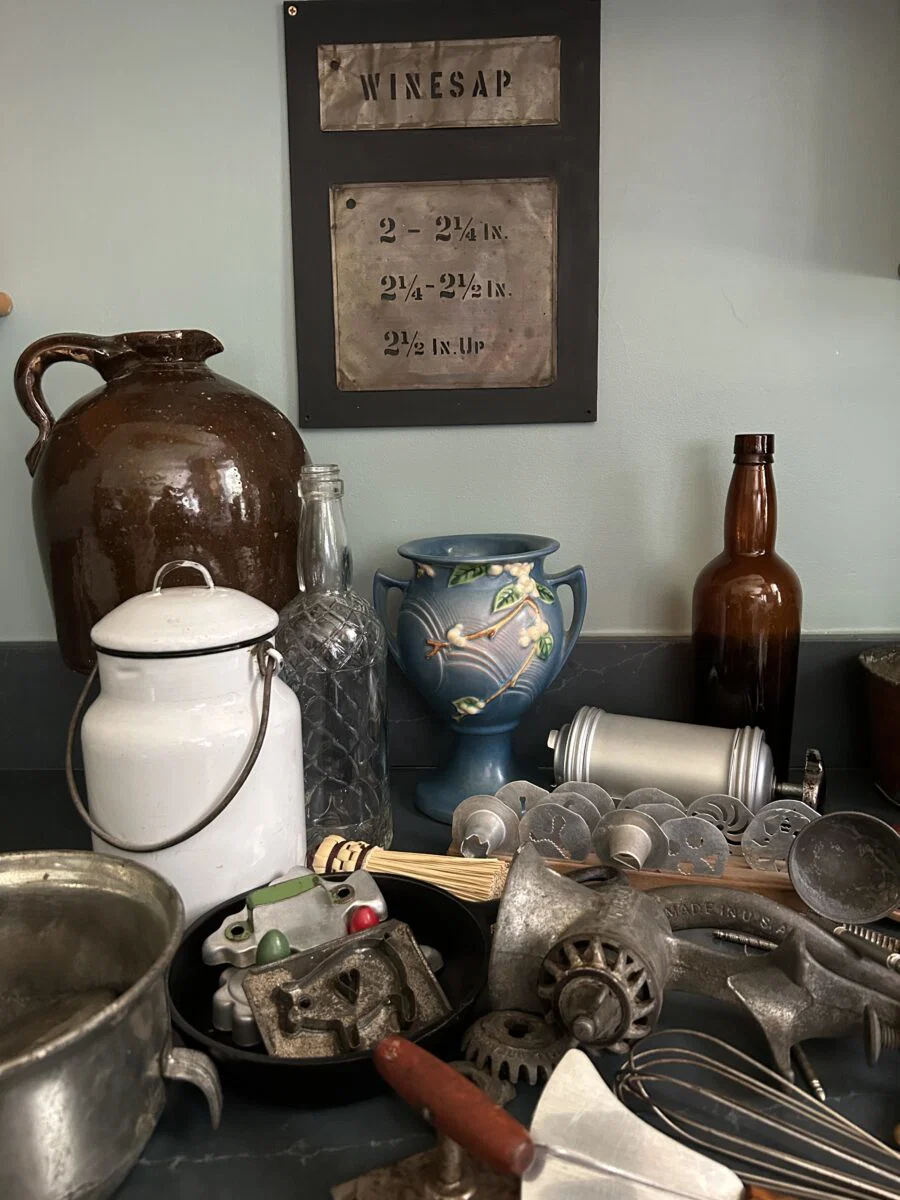
Recently, I served as a docent for an historic homes tour in my rural county. The ‘captain’ thought I’d be the perfect match to a room containing a collection of old tools having been a woodworker for many years. At the pre-tour meeting and walk through, I was a little surprised that the ‘tools’ were in fact mostly kitchen utensils and nineteenth century mechanical gadgets with only a few woodworking tools included. Most of the objects were familiar to me: an upright (barrel) butter churn, a clothes wringer with oak stave tub, and a cider press. My family, though not country folk, routinely used a cast iron apple peeler, an aluminum cookie press, and a meat grinder which we used to make cranberry relish (cranberries, cored apples and oranges with rind). A friend of mine had a small cider press which was the centerpiece of an annual fall gathering of friends.
I was gratified that the white-haired elders who passed through knew most of what I knew. As the age of my guests became younger, there was less recognition and perhaps less interest. Until, much to my delight, a not-too-shy eight-year-old identified the butter churn, cider press and apple peeler. She was proud to have made butter and apple juice with her mother.
By confession, there were several devises that were unfamiliar to me though I may have seen them in some antique mall booth. I surmised that one was a rotary meat slicer, similar to a modern deli meat shaver, and another, a cylindrical hunk of iron, was a meat (sausage) grinder with rows of internal blades. I hunted the shelves displaying product containers, treen (wooden utensils) and a 1902 Sears-Roebuck catalog, for the cherry pitter listed on my crib sheet.
To make exploring the room more interesting, I was sure to show my excitement concerning three objects. I called attention to the dining room table upon which some tools were displayed, and noted that it was one single oak board about twenty inches wide, eight feet long and two inches thick. I asked the visitors to imagine the size of the tree that could contain such a knot-free plank. I noticed eyes widen, the head cocked back as if looking skyward.
Then I pointed out a brass spigot projecting from the front of an Eastlake style cabinet which had a mirror in the ornamented back. In my ersatz befuddlement, I asked why would such a thing be on “this fine dresser.” I paused. I lifted a wood panel from the countertop to reveal a compartment for ice. Ah! I heard them say. Then I opened the doors below to show a metal lined refrigerator. Flatly I stated, “Ice melts.”
My crib sheet listed a “slaw cutter” (for coleslaw) and after some inspection, I matched the description to a contraption resting on a side counter. Of course, I had to see how it worked. Turning the handle turned a series of gears which in turn caused a rocker arm to move a heavy blade up and down in a galvanized bucket. An attached rod simultaneously pushed on cogs that ringed the bottom of the bucket rotating it. Having placed my invisible cabbage in the bucket, a few vigorous turns of the handle would slice-up the head of cabbage as it was rotated into the cutting area. Amused, some guests commented that a large (and sharp) kitchen knife could accomplish the task with little clean-up to which I wryly said that there were large families back in the day and church dinners and barn raisings and weddings and. . . .
Most guests said little, though some reminisced about their mother’s or great aunt’s kitchens. No one questioned me. During a lull in traffic, I wondered what attraction the old and obsolete holds. Some people may be thankful they don’t have to use onery or ‘primitive’ gadgets, not realizing how new and awe-inspiring these tools were to their owners. Others, no doubt, appreciate the expertise and perseverance of earlier generations, their labor and their time.
Next time I’m rummaging in a stall of antiques, I’ll look for a slaw cutter, not that I need one. At least I’ll know what it is and perhaps other antiquers will think I’m older than I am like those on-line “Do you remember” quizzes aimed at pegging one’s age.





Share this post with your friends.

