
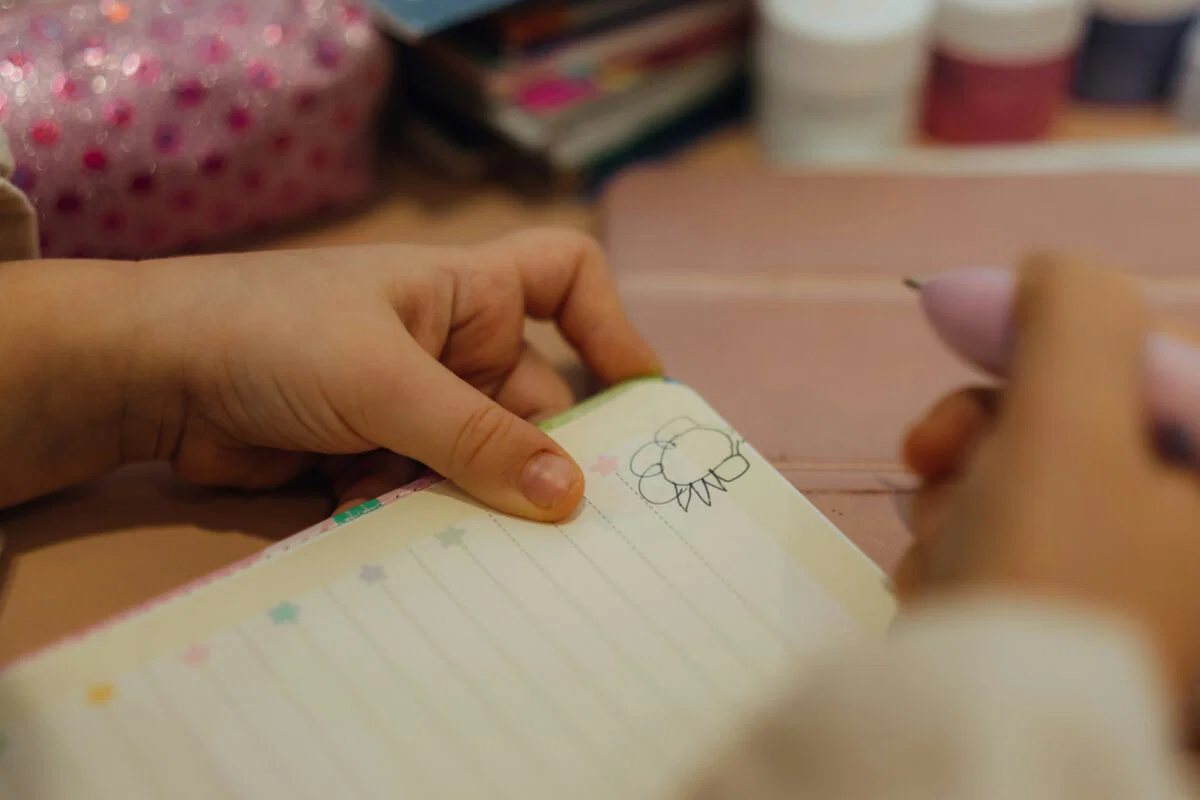
One day after school, I stepped into my room and immediately felt that something was wrong. My eyes darted to the bed, and my heart stopped. The mattress was gone. My diary—the one I’d hidden so carefully beneath it—was missing too.
I rushed to the balcony, where laundry usually fluttered on a frayed line. There it was: my palm tree mattress, spread out in the sun like a giant pancake. But my diary was nowhere to be found. Someone had discovered it. And deep down, I knew exactly who.
Then my father appeared from another room, his silhouette casting a shadow across the floor. His expression was stern, and in his hand was my diary.
“We need to talk,” he said, his voice cold and final.
There was no question what this was about.
Dad led me into the living room and motioned for me to sit across from him on the bamboo stool. The diary lay between us like a weapon, its spine opened just enough to suggest it had been read slowly, thoroughly.
“I am embarrassed. No—you should be embarrassed. You should be ashamed,” he began, his voice sharp like the edge of a blade. He paused, shaking his head as if the words tasted bitter. “How could you let this happen? At such a critical time in your life, when everything depends on your studies, you waste your time thinking about boys?” His voice rose, sharpened by anger and disbelief. He held the diary up, waving it like a piece of evidence in a trial.
Heat rose to my face, my chest tightening under the weight of shame. I couldn’t meet his eyes. I couldn’t say a thing. Every word I had written, every private thought, now exposed. The diary that had been my refuge was now in his hands. I felt stripped bare, defenseless.
In China, in my family, privacy wasn’t a right. I knew that. But knowing didn’t soften the violation. In my diary, I had written about everything I’d been holding in my heart—including Jian, a classmate I had started to like. I had described how my heart beat when he looked at me, how my stomach flipped when we passed each other in the hallway. These were things I’d never told a soul—not even my closest friend. Certainly not my parents.
“Your grades have been slipping,” he said. “And now we know why.”
His words blurred together as he continued, scolding me about my future and how my focus needed to be solely on my studies. Do you realize what’s at stake? Your entire future depends on your education! His lecture stretched on for an hour, maybe more. But after a while, his voice faded, like a radio tuned to static. I couldn’t hear him anymore—or maybe I just didn’t want to.
All I could think about was my diary—my most private thoughts laid bare. Shame and humiliation washed over me, wave after wave. I wanted nothing more than to vanish, to find a hole deep enough to bury myself and never be seen again.
When it was over, he handed the diary back to me, as if it were a weighty sack of shame, too heavy for either of us to bear.
Later that night, the diary—the one he had read and criticized—sat on my desk like a thing badly defeated. I opened it to a fresh page and wrote:
Dad read my diary. I felt like I was stripped naked before him. Every flaw laid bare and criticized.
Then I carefully closed the cover, as if by doing so I could fold the pain back into silence. I slid it into a new hiding place—deep inside a folded sweater at the bottom of a drawer, somewhere I thought no one would ever find it again.
Two decades later, after I had moved to the U.S., my father came to visit. Dad and I sat in the kitchen, exchanging the kind of small talk that usually feels safe. But eventually, as if the words had been waiting for the right moment, I brought up the diary incident.
“Do you remember my diary?” I asked.
He did, even if it took him a second.
“You took something from me,” I said. My voice was steady. “Not just the words. You made me afraid of myself.”
“I was just an innocent teenager who had normal feelings,” I said, my voice trembling.
“But you read my diary, criticized me for what I wrote—why would you do that?”
Dad froze, his hand hovering over his teacup. After a long pause, he set it down slowly.
“Back then, in that time, in that culture . . . I didn’t think it was wrong.”
I stared at him, disbelief turning into anger.
“There’s no excuse for it. None. Do you have any idea how much it hurt? None of my friends’ parents would ever have done anything close to that. You and Mom—you were so strict with Dandan and me. We were constantly yelled at, slapped, spanked. We barely ever felt . . . loved.” My voice cracked, the weight of years of hurt pouring out.
He didn’t flinch.
“We did the best we could at the time,” he snapped, his voice rising to meet mine.
I didn’t know how to respond—or maybe I was too angry to find the words. I’d made my point. He was always stubborn. It would take a miracle for him to admit he was wrong.
The room fell silent. The tension hung between us, thick as the dust in the corners. Then, without a word, he stood and walked out onto the porch.
I watched him go, the screen door creaking as it shut behind him. Through the window, I saw him light a cigarette, his silhouette barely visible in the dark.
About ten minutes later, he returned, calmer now, moving slower—as though he’d wrestled with something and come back changed. He sat down across from me, the faint scent of smoke lingering in the air.
“You know,” he said quietly, “things weren’t easy for us back then. We did what we thought was right.”
It wasn’t an apology—not really. But it was more than I’d ever expected. And for my dad, it was a lot.
The diary incident had lived inside me for decades—an unspoken ache, quietly gnawing at the edges of my heart. It needed air. It needed to be named. I didn’t completely forgive him that night, but I felt something shift—something like closure.
That conversation didn’t return the privacy I had lost, or the girl I’d been before that afternoon. But for the first time, I saw my father not only as the man who scolded me, but as someone shaped—like I was—by his time, his fears, and his limitations. It loosened something in me that had long been stuck.
And in that release, something like healing began.
Author Note:
This essay is adapted from Made in Two Worlds, my memoir about growing up in
Communist China, crossing oceans, and finding voice on the other side.




Share this post with your friends.

