
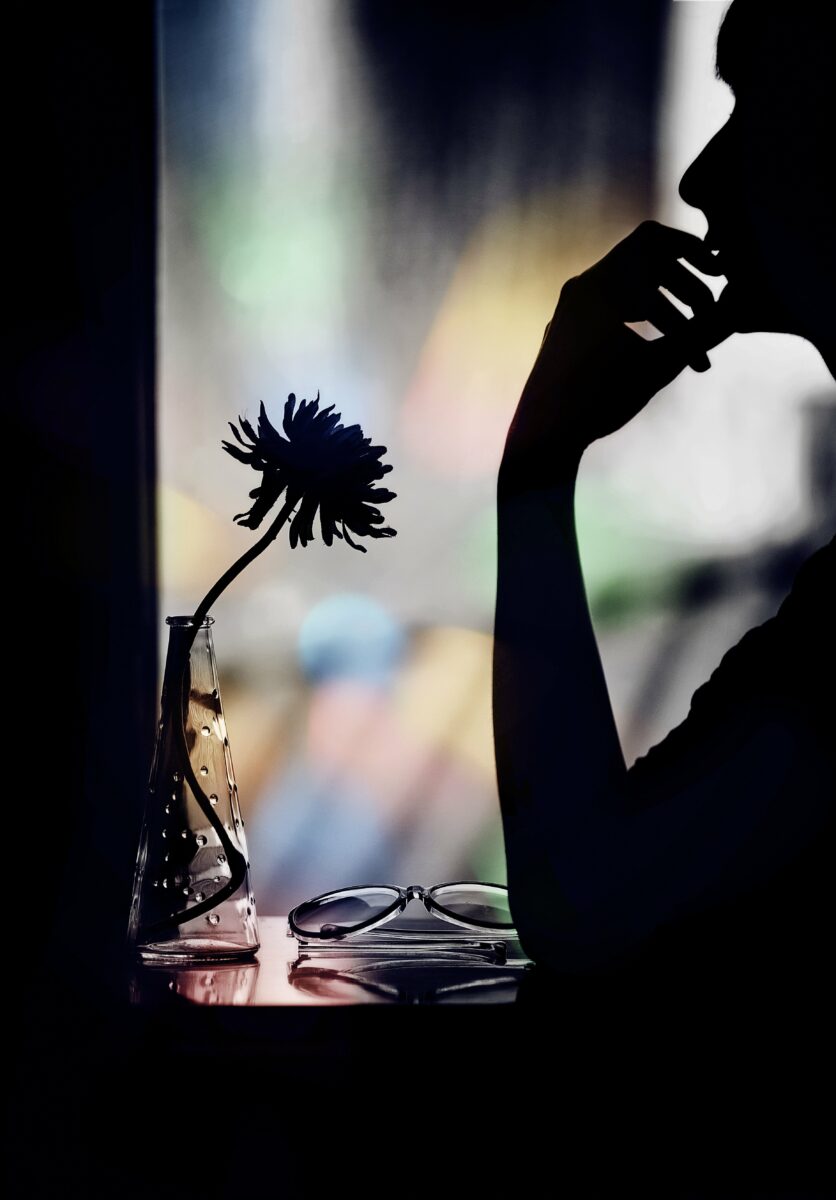
On some days, the world stops moving and I feel I’m sitting on a wooden chair inside a still life painting. I look at the objects around me in my living room—the navy blue fabric recliner, music magazines on the coffee table, the wooden perch near the window where Sophie, my black cat, sleeps. The painting on the wall of the Mist Trail in Yosemite by my mother before she faded into dementia—the rocks, trees, and waterfall dissolving into colors—magenta, light blue, crimson, shades of charcoal gray, and forest green. The red coffee cup, the knees of my fading blue jeans, my hand pausing over the notebook on my lap where I’ve scribbled half a sentence about the possibility of ceasing to be. I can’t find the words to describe this unknown and finish my sentence.
Moments like this started happening when my urologist said I had aggressive cancer. My breathing and time stopped moving for a long moment, and the future I envisioned disappeared.
In my living room, I try to describe what this scene evokes in me, what it draws out from somewhere inside. What is waiting for me to notice? An insight into the meaning of cancer? Is there any meaning in having cancer? A deeper fear about what is coming next? A fear of dying? Or despair that there is nothingness waiting instead of
heaven?
One day, I was chatting with my friend Mary Beth in her independent bookstore as she helped me find Gretel Ehrlich’s The Solace of Open Spaces. She talked about the good books coming out from small publishers and how much she hated Amazon. Instead of rushing off, I lingered, and we talked about how our lives were going, her tenuous health, and my recent news of cancer. A week later, after posting her Wordle score, she died of a heart attack.
I remember her inviting me to read from my Yosemite book, and her sitting on the side and nodding appreciatively. Afterwards we shared a glass of wine and talked about how to encourage young people to write more poetry. Today there is stillness when I peer in the front window of her empty store, but I continue to see shadows of her ringing up customers at the counter, setting up a display of new books on the round display table,
talking to someone on the phone.
While hiking the rugged trail through the hills of Peoria’s forest preserve, I take a break and sit on a bench at one of the resting spots that identify places to listen to the sounds of the woods. At first I hear only the breeze feathering the hickory and oak leaves glowing green in the noonday sun. The birds and squirrels have disappeared, cautious about a stranger in their midst. I let the warm solitude of the woods embrace me, and the
presence of nature settles in. Two crows call to each other across the glen, and all is quiet again.
Motionless, I listen and watch. Gradually the wrens, cardinals, and black-capped chickadees return to the bushes nearby and resume chatting about the day’s events. Squirrels begin chasing each other around the trees, and a doe and her fawn emerge out of their hidden place to nibble acorns.
Even if I’m not dying, the stillness of death settles inside. Cancer is unpredictable and mysterious. I try to imagine what not being here will be like. I can’t. My words falter.
I don’t know what comes next. I can’t pierce this wall. If a neighbor walking by on the street looked in my front window, would they see me sitting in a still life, or see the shadows of where I used to be?




Share this post with your friends.

