
My memories of the time when my parents and I lived in a renovated gristmill are of course dim—I had only been two when we moved there and four when we left—but they are my first memories, and they are filled with tone. I remember the narrowness of the house, with two rooms on each of its three floors, and the oldness, darkness, and coolness of its log interior. I remember my mother’s shiny stainless-steel percolator in the basement kitchen, and its swish-and-gurgle pattern that sounded like labored breathing. I remember the kitchen stool, which I used whenever my mother was on the phone to climb to places I was not allowed to reach. I remember the barn across the narrow lane where our horse was kept, and watching my father from the second-floor screened porch as he rode. I remember the uphill sweep of the cool and shadowy lawn, big trees, and a tiny creek. I remember the exotic smell of our new rural environment, leafy and brown and green and damp—the smell, I now know from long years’ intimacy, of Virginia.
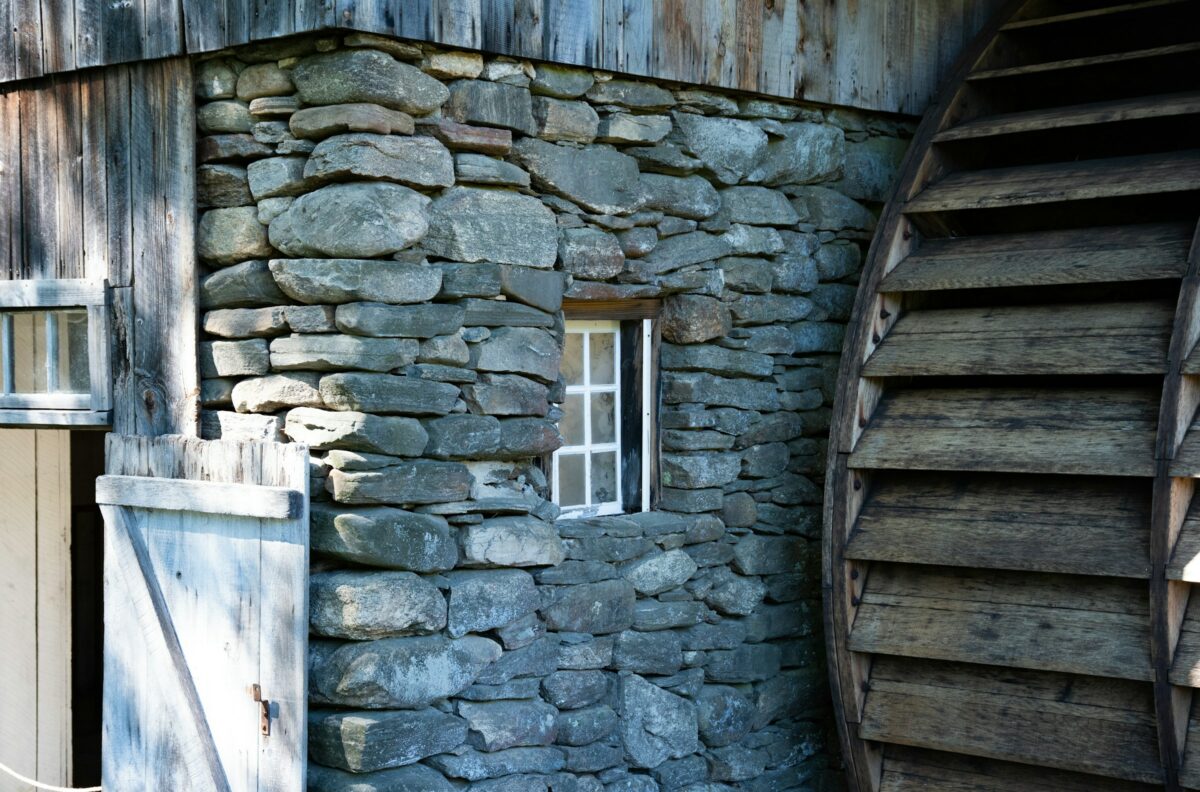
Few people, I came to realize later, live in gristmills. But somehow, even then, when I could not have had a frame of reference for gauging the nature of how I and my family lived, I had the unformed sense of living out of time, in a space and reality outside of what was real when we got in the car and went somewhere else, to the doctor’s or the grocery store. The oldness of the house and its odd shape, the deeply dark lawn, the insular world of reading and gardening that my mother and I shared day in and day out, and the vibration of excitement that entered that world when my father returned from work or was home on the weekends—these were simply not the stuff of the bright, fast, clickity-clack world accessible by car. It seemed to have little to do with us.
I have a black and white snapshot of myself from that time taken on the dappled lawn. I look about three. I am wearing a farmer’s straw sunhat tied under my chin by a scarf. I have on a little blouse with a Peter-Pan collar and loose pedal-pushers, and saddle shoes and little white socks. In back of me is the stone springhouse, sheltering the headwaters of the tiny creek, and near that the old-fashioned motorless push-mower. I am not looking at the camera, but smiling at something off to my right, a hand on the brim of my hat. As a whole it does not look like a picture that could have been taken within my lifetime; equating it with the fact that I was born the year that Jack Kerouac published On the Road is simply impossible.
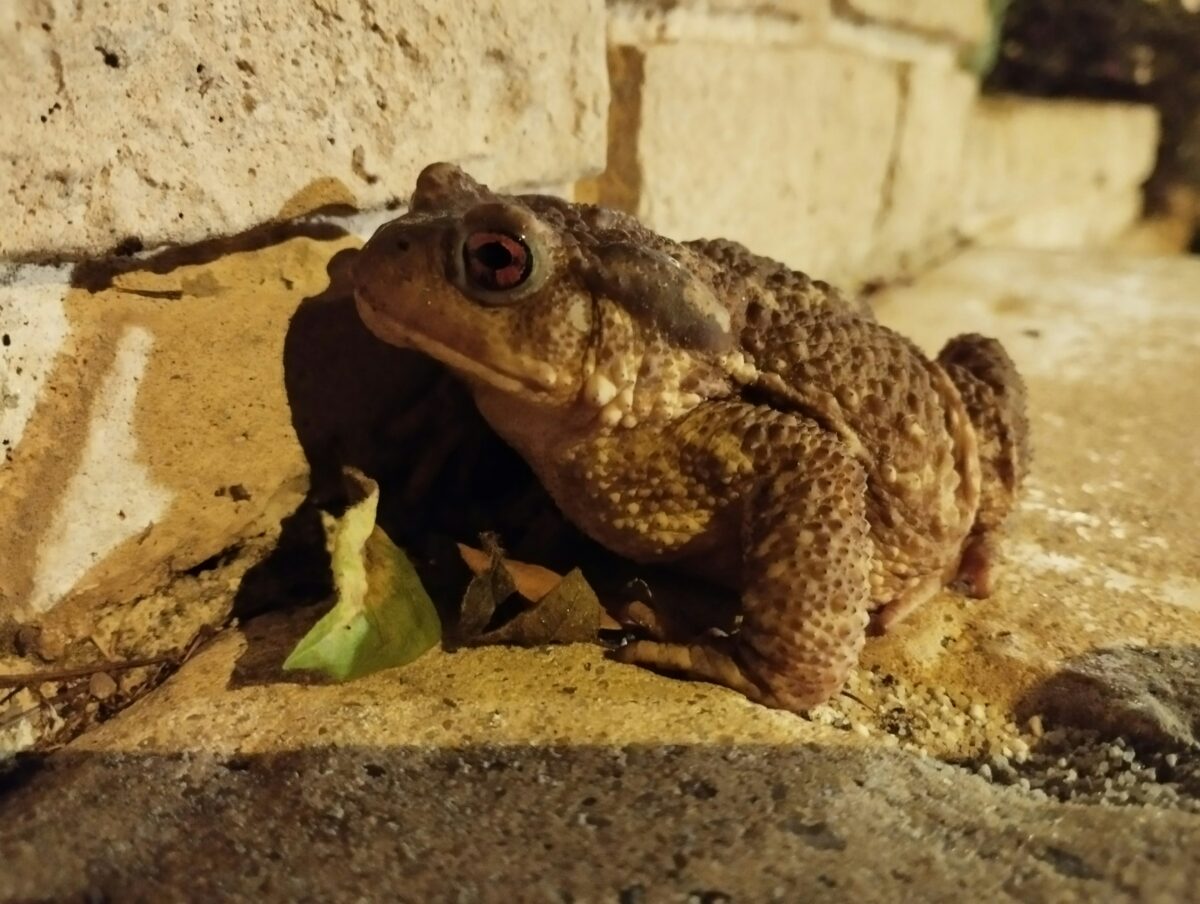
Though this extremely small and otherworldly kingdom had lacked certain trappings of a childhood—chief among them other children—there were some unusual things that were there that could only be seen as bonuses. One of these was the toads.
Perhaps because of the spring and its sweet flowing creek, the McGrath House—for thus it was always called, after its owners, who were not my parents—the McGrath House was home to a plethora of outsized toads. I discovered one near the front porch one summer night, and the following night had begged to go back out and see if it was there again. It was, and so it was promptly named King Arthur, and designated my special friend, a distinguished visitor. The next night I went out earlier so I could stay longer with him before being called to bed, and there he was—and there, to my delight, were a couple of other toads, outside the orb of the porch light, watching.
With my father standing above me on the porch, I was allowed to go down near the toads. I squatted as close to King Arthur as I dared without risking his hopping away (this I remember), and began (according to my father, years later) to speak to them. He said he could not understand or hear what I was saying. But the toads that were camped outside the light move forward, a shuffle and a small hop at a time, until they sat by King Arthur, gazing at me. I spoke and spoke, my father said, droning calmly, and the toads sat calmly too, gazing and gazing.
How fortuitous that I had chosen a name that lent itself to an expanding group! The new toads were christened Lancelot and Guinevere. The next night there were more, and the next night more. My father always deemed it one of the most amazing sights he had witnessed, a dozen or more toads, arranged in a semi-circle around his tiny daughter, apparently both brought and held by her indecipherable murmuring.
I remember only the feeling of magic, and of companionship, of coming outside and saying, Yes! There they are again! Hello, King Arthur! Hello, Lancelot!
…
My memories of the McGrath House are all of perpetual summer, and several important summer rituals took place on the McGrath House’s second-floor screened porch.
As soon as spring gave way to summer, my mother would take me out onto the porch at dusk. We sat on the lawn chairs, my mother still in her gardening clothes, and we watched for fireflies. My mother was so close I could smell the clean smell of sweat from her work, and see her profile in the soft light, whose dimming drew us ever more deeply into a sphere of our own. We counted the fireflies as we saw them until there were too many to keep track of, their magical burnings as spectacular as the night sky. My mother delighted in them as much as I did, her voice becoming light and breathless as she would exclaim, “Ooh! Another one!” We discussed how like fairies they were—though not to be confused with fairies, of course, since fairies were real just like fireflies were real, two distinct types of beings, the former of which were simply very hard to see. But that did not mean they did not exist! Not at all. On this point my mother was firm.
On the screen porch we also watched in the summer evenings for my father to come home from work, far away in Washington, D.C. This ritual was less predictable, both in its opening movements and in its outcomes. Fireflies, after all, appeared without fail, at the same time, every single night, all summer long.
Some nights, watching for my father was simply folded into watching for fireflies—my mother and I would stop gardening, go inside and get a cool glass of iced tea, and go up to the porch. At some point in the firefly count, my mother would say, “Daddy will be coming along soon. We can watch for him. Let’s try to guess which lights are his.” Most evenings this worked out just fine, and my father appeared as magically as the fireflies. On other nights, my mother and I sat and sat, long after the firefly count had ceased, until there was no way to delay starting dinner any longer and the air around my mother had taken on a slight shimmer, as if something unseen were vibrating very nearby. My mother’s voice became higher and more chipper, and I said nothing. Eventually we went inside.
On other, infrequent evenings, my mother stopped gardening early, came inside and took a bath, and put on a pretty dress. She would shake up a batch of clear, sharp-smelling liquid at the bar and put it and two skinny glasses in the refrigerator, where they got a frosty coating on the outside. Then she and I would go up to the porch and wait.
On these evenings it was guaranteed that my father would not come home until we had left the porch. We would sit long into the darkness, not talking.
One night I heard my mother murmur, “When I do this it never works.”
Hearing the tone in her voice was like being unexpectedly jabbed by a needle, and I realized with shock that my mother felt sad. I was terrified, and yet I could not stop myself from asking, “If you know it doesn’t work why do you do it?”
My mother turned her elegant gaze on me and contemplated me for a moment through the near darkness. Whether she was trying to find the answer, or trying to decide whether she should share the answer with her four-year-old daughter, I do not know even now. Finally my mother looked down at her hands.
Though I had no words for it, I understood in that moment that my father’s unpredictable returns were freighted with some greater complexity to which I was not privy. There are no memories of what happened next, or if there are, they are swirled in with the memories and emotions of another dozen years’ worth of waiting and conversations about waiting, of confusion and anger and anxiety. But at four, the weight of my mother’s transparency proved too much for me; the aftermath of the moment was not recorded.
The snagging, lurching realization of my mother’s sadness, however, remained vividly intact, along with the impression that, within the magic kingdom of my out-of-time life, my father retained more of a bridge to the clickity-clack world than my mother and I did. It was as if he were an emissary from another, realer place—realer because it could command him at will, realer because his life was made of going there and then coming home when he could, rather than the other way around. I see him in the yard hard at work, a lock of hair fallen across his handsome forehead, or in the barn, or training our perfectly-trained dog, or reading in the den beside a golden lamp, the glow of him too beautiful to be real. He was solid and safe and boundlessly loving when I crawled into his lap, and when I spoke he gave his undivided attention, with a serious, focused expression that I knew instinctively was the same expression he wore at the clickity-clack Pentagon, doing important things with other grown-ups.
Somehow, though—somehow, they could both slip away from me. My father could get into his car; and my mother, though guiding my every step and movement with the steadfast glow of a lighthouse, could drop her eyes, shift her tone of voice, and retreat beyond reach, into the fearful, mine-strewn land of her shapeless discontent, where I dared not go.





Share this post with your friends.

