
The way down is always harder than the way up.
On the way up a mountain, your muscles strain to push you vertically. Going down, you’re already tired and you’re fighting gravity to keep from falling. And fall I do, slipping on mud covering a smooth rock, and tumbling face down, my eyeglasses rocketing into a nearby tree.
When I was younger, I didn’t think twice about hiking up a mountain. I enjoyed the challenge and the soreness that followed, my body’s signal that I had accomplished something special and was fit enough to do it. That’s when I was younger.
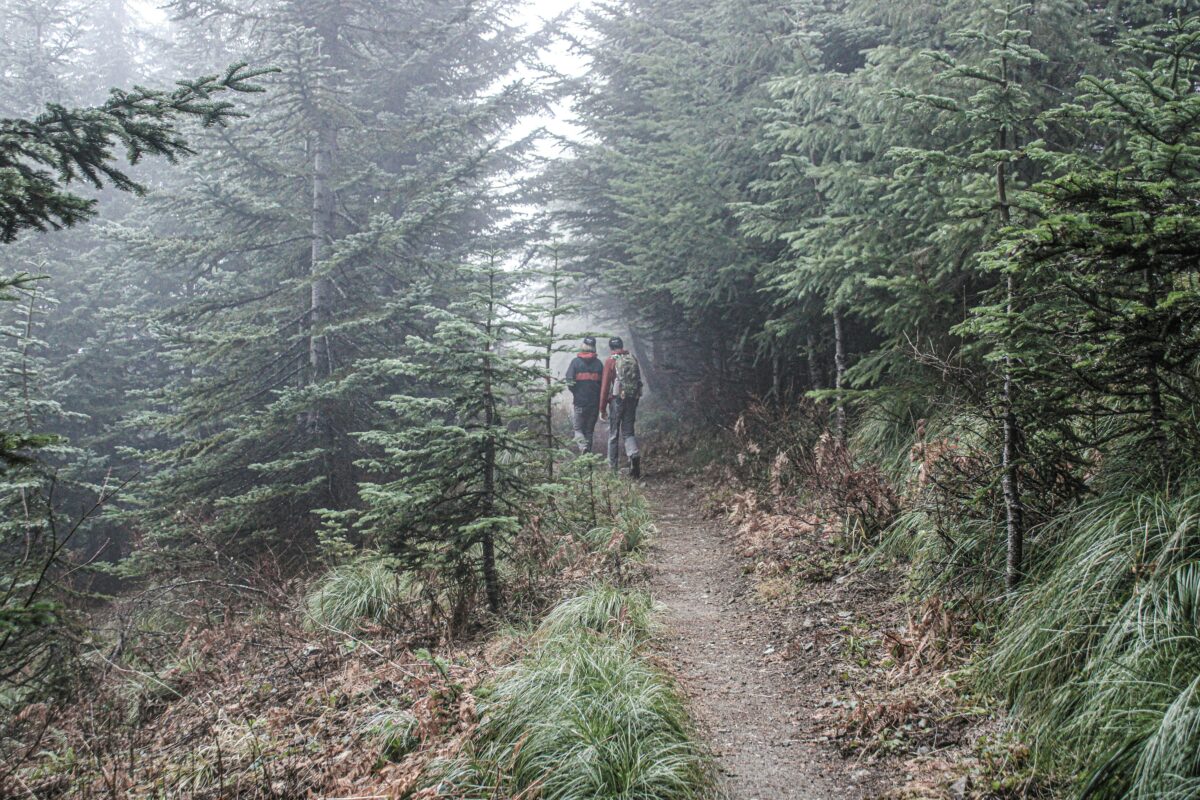
Several years ago, a colleague asked if I’d be interested in hiking with him occasionally. I was experiencing back problems at the time, so I gave a non-committal “maybe” and let the matter lie. After recovering from major back surgery, Ron’s invitation came back to me. For the past several years, we have scheduled a hike every month, year round, without fail. We have hiked in several New England states, in sunshine, in snow, in ice, in rain. Afterwards, we go out for coffee or breakfast. On rare occasions, like a medical issue, or when the ice and snow seem too daunting, we just get breakfast.
Ron and I started hiking together toward the end of our long careers as psychologists. Our hikes have taken us through our ambivalence and sense of loss at letting go of our professional lives that have formed the core of out identities and have provided us so much meaning, our attempts to find significance in new endeavors, and our struggles to adapt to our roles as parents of adult children. We have discussed finances, families, books, movies, religion, politics and philosophy. In my journey to be a writer in my seniority, Ron has read my work and offered intelligent commentary. When we were each faced with serious medical concerns, our hikes became natural settings in which to discuss them.
There is something about the structure of a planned monthly hike that provides the freedom for a close friendship to develop. It has always fascinated me how limitations can enhance freedom and creativity. Take haiku poetry, for example. Who would believe that restricting oneself to seventeen syllables in a five-seven-five pattern could produce so much variety and loveliness. And that form, of course, can be altered, so the artist need not be straightjacketed by inflexibility, but only so far if it is still to be considered haiku. And then there are Shakespeare’s sonnets. The beauty that can be created with that form is infinite.
Our friendship developing in the containment of set times, places and activities somehow gave us the freedom to discuss anything and everything, and I think that I have shared more of my internal life with Ron than I have with just about anyone except my wife. It is a rare thing to develop a close connection late in life, with everyone busy with their own obligations and families, and restricted by their habits and hangups.
In a fiction writing workshop I attended, the leader spoke about how easily we find that we can write about our characters’ thoughts, feelings and perceptions but, to make these compelling for the reader, this internality must be framed and structured by the physicality of the real world, the body, one’s actions. Characters must occupy physical space; they must breathe and move and do and talk for their internality to come alive. This is what our planned and structured hiking has allowed us to do.
Ron and I are now both in our seventies. Our talks turn more toward the spiritual and the soulful, our vulnerabilities and anxieties, what fulfills us and what doesn’t, and how we want to spend our time. Less energy is given to gossip, trivialities and minor annoyances. Of course, we still discuss what makes a great cup of coffee and Ron’s obsession over his lawn.
When we are younger, we are preoccupied with building: our families, careers, relationships and communities, fighting the downward pull of gravity and the dissolution of entropy. What do we do when the building stops and we feel more acutely that gravity and that entropy? In his poem, “East Coker,” T.S. Eliot wrote: “Old men ought to be explorers . . . We must be still and still moving . . . Through the dark cold and the empty desolation . . . In my end is my beginning.”
Ron and I know and expect that life is imperfect, often agonizingly so, and we have given up the illusion that there is much we can change. But our hikes have us, literally and figuratively, still moving, and moving forward, as we push through the boredom, the sadness and the ennui that often comes at this stage of life.





Share this post with your friends.

