

Scroll to the end of the interview for excerpt from Making Rounds.
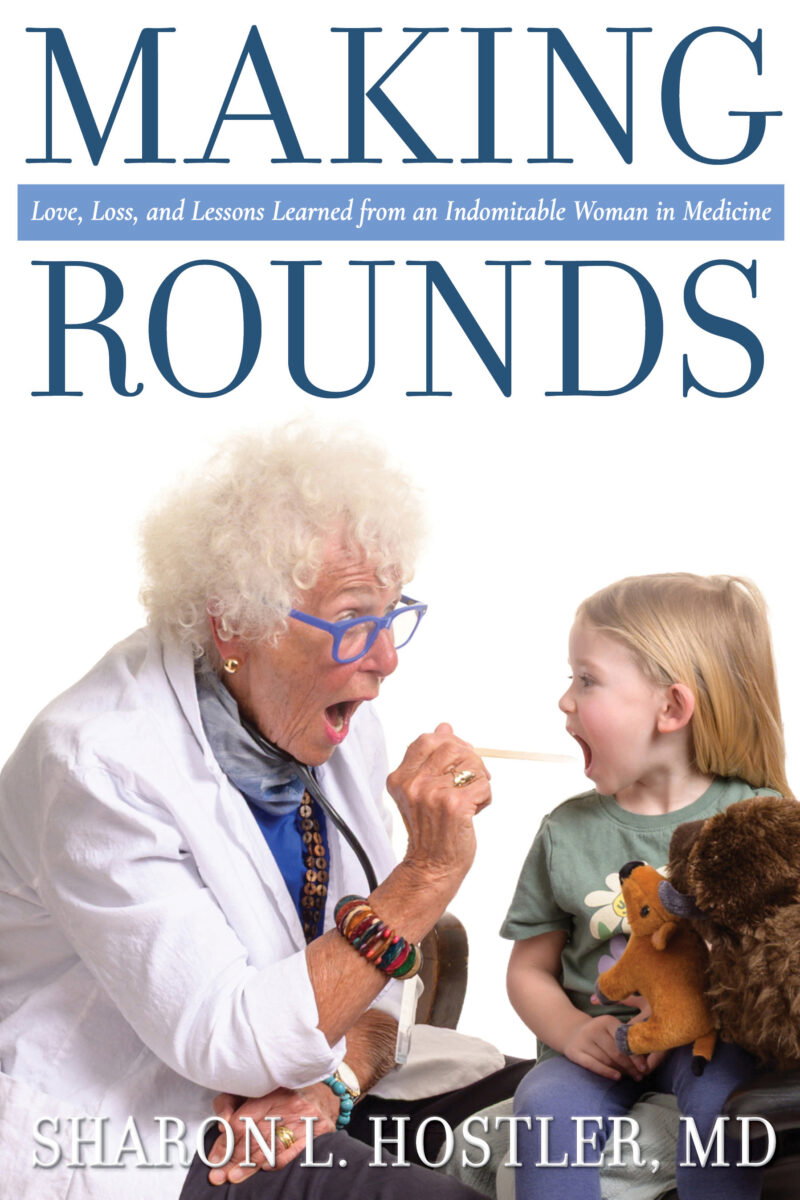
In her new memoir, Sharon Hostler writes candidly about her life, both professional and personal. We see her raise two children while also becoming a major force in a new model of patient-centered care. We watch her wrestle not only with the obstacles society imposed on her, but with her own preconceptions. Her insights into how race, gender, and class shaped different people’s medical experiences are fascinating.
The memoir takes us from her difficult childhood in Vermont to her against-the-odds career in academic medicine in Virginia. When she entered medical school in 1961, only 6 percent of students were women. When she arrived at the University of Virginia as an intern, she was an outsider in more ways than one: a Yankee woman, without a husband, from a working class family. She soon learned that skin color now made a difference for more than diagnostic reasons. There were new hospital expectations and new social rules.
And yet she survived. She became a mother and then a young widow. She even came to recognize and fight against her own internalized misogyny. Finally, she became a powerful advocate and mentor for women in medicine.
But I met Sharon Hostler first as a writer. We gathered around a table at WriterHouse, a nonprofit literary center in Charlottesville, where I teach. She signed up for my memoir class, with seven other writers. After that first session, the pandemic hit and the class moved online, where we continued to meet for two years.
Former UVA president John Casteen wrote about Making Rounds: “Sharon has made her mark and so she might be forgiven if she had written a self-congratulatory book. But she has not done precisely that.”
I’d read Making Rounds in draft form, but to prepare for this interview, I read the latest version straight through as a regular reader would. Even though I knew how it would end, I found it gripping and moving. I pulled a few quotes from the book and shared them as we talked.
We spent an afternoon chatting in her study. Her two cats lounged on my phone while it recorded.
Q: In the acknowledgments, you say the book started as your experience at UVA Hospital during the Civil Rights period.
A: I initially thought about putting together my patient stories from those early days. There are patients many of us have that are formative and often magical. And they stay with us. Some of the young patients, especially the ones with leukemia, were heroic. So were their families. I remember how wise some of the little kids seemed, by the time they got to the point of actually dying. They had such suffering and such intermittent joy. I felt privileged to watch—like a voyeur, in a way—because I didn’t have that kind of family, protective and supportive. When I was growing up, it was more like a war zone. So I was respectful of the magic those families had around their kids and their tremendous grace. They are very precious to me. I once said on grand rounds, I learned everything I know from my patients. It’s a well-worn phrase, but there’s truth to it. And then later on, with the adolescents sharing their issues with me around sexuality, teaching me again about the developmental tasks and how that varies if you’ve got a chronic illness.
Q: The book grew to be more than a collection of patient stories. It’s about race, for one thing. Here’s a quote:
“One pediatrician in town used a covered back porch as a waiting room for his ‘Colored’ patients, examining them only after all the White children, rich and poor, had been seen. Another practice maintained separate waiting spaces indoors, but the ‘Colored’ children still waited until all the White kids had been seen. There were two Black physicians in Charlottesville that I knew about. Neither had admitting or referral privileges at the hospital.”
A: I came to UVA Hospital as a pediatric intern. In those days, it was one year of internship, three years of residency and two years of fellowship (in pediatric hematology). It was 1965. That year, two things happened. One was the passage of Lyndon B. Johnson’s Civil Rights Act, Part 2B, which states that no hospital receiving federal funds can be segregated. That law was not enforced, so the local NAACP sued the hospital for maintaining segregation. But as residents and interns, new to the hospital, we were not told that the process was happening or told what the process was. We just kind of bumped into it now and then. For me, it was strange. I’d grown up in Vermont. Our prejudices were directed towards the Canadian immigrants. My father’s family were Canucks, and they weren’t welcome. And after Vermont, I’d spent my senior year of medical school as an acting intern in Puerto Rico, where about a third of patients were of African origin, which was a patient group I didn’t have experience with, so I misdiagnosed a child with sickle cell and treated it like arthritis, which was absolutely the wrong thing to do. I learned my lesson when that little baby was still screaming the next morning, then immediately got better with morphine. I knew Virginia would be different from Vermont, that patients would have different skin colors, but I thought that would only matter when trying to diagnose things like sickle cell versus arthritis. Maybe that was naïve. So when I came to Virginia, I was stunned.
Q: Here’s another quote from the book: “My last rotation of third year was pediatrics in late spring of 1964. By then, I knew I was not going to be a baby doctor.” Why?
A: First, because childhood wasn’t my favorite part of my life. And second, because, as a woman, you’re told you should be a nurse, but if you want to be a doctor, you should be a baby doctor, because that’s a specialty that has the lowest status. So no, I wouldn’t do that.
Q: And yet you did.
A: It turned out that the Department of Pediatrics at the University of Vermont had a really outstanding department, and they had a very interesting curriculum. One of the things we had to do in that curriculum was feed babies in the hospital. I thought, Who couldn’t do that? Well, it’s not so easy. And there was something magical about doing the 2 a.m. feed, with the mothers rocking their sick babies and the camaraderie, which I returned to much later as I promoted something called family-centered care.
Q: Let’s talk about that. In the book you write, “We were one of several groups across the country grappling with the role of families that eventually mobilized around the concept of family-centered care. . . . Parents became significant advocates for their children and their rights as parents to participate in decision-making and be present at bedside and during treatment.”
A: FCC was a revolutionary.
Q: When the new children’s rehabilitation center building was being planned, you asked for parents’ input.
A: And they said, “What we want is respect.” We thought they would want to talk about parking. Or better lobbies. So that conversation was a game changer.
Q: You write about how the mothers of your patients sometimes teased you, when you weren’t yet a mother yourself. So there’s the evolution of you not wanting to be a baby doctor to falling in love with the babies during the 2 a.m. feedings to then being jealous of what those mothers had, the camaraderie.
A: I certainly didn’t have it as the only woman—or at least almost the only woman doctor—on the floor.
Q: One of the major arcs of your book is how your relationship with other women changed through the years.
A: At the beginning, I just wanted to be one of the boys. I wanted to be better, brighter, and as badly behaved. I took on some of the aspects of the guys, to my own detriment. They didn’t want to see that behavior in a woman. They didn’t want to compete with me, even though I was trying to compete with them. And I was ignoring the nurses, who were actually my supporters. They’re the ones who helped me examine a snake who had bitten a child—and I was terrified of snakes. The first time I began to realize that nurses were my allies was when we were doing exchange transfusions on a child during my internship year, and a nurse said, “They only tease you because they respect you.” (She was referring to Drs. Birdsong and Thurman, the faculty leaders, not the male faculty in general.) That’s when I realized the nurses were not against me, even if they harassed me for not wearing white hose and white shoes.
Q: And women were the ones who supported you after your husband Alan died so young in a plane crash.
A: I wouldn’t have survived without the women. There are several groups—like the women working in the Children and Youth Project, the women out in the clinics, doing home visiting— they taught me so much about kindness and respect. Those home visits to patients living in poverty, they were very difficult for me, because it felt like I was going into my own childhood home.
Q: The Children and Youth Project was part of Johnson’s War on Poverty initiative, right? There were two in each state, one urban and one rural.
A: They were funded for fifteen years, I think. I owe so much to the women working with me there, who were very comfortable challenging my sort of tertiary care version of medicine. They told me things like I didn’t need to prescribe iron when I could just make sure the patients had peanut butter.
Q: Here’s a quote: “Helen fussed at me from day one. ‘How many times do I have to remind you that this family has no running water? Stop telling folks to soak in hot water and scrub with soap. Not going to happen. If you want the sores to heal, prescribe the topical antibiotic. Why are so you darned stingy?’”
A: Helen Wright was the nurse at the clinic out in Esmont. Clarice Harris was the nurse at the city clinic. Helen has died, but Clarice is still alive.
Q: Both Black nurses.
A: Yes. And they were absolutely fearless. They knew so much more than I did about the world outside the academic medical center.
Q: And the women at the Children’s Rehabilitation Center taught you a lot.
A: There were men and women there, but mostly women. I learned how to work in an interdisciplinary team with mutual respect across professions. They taught me to recognize that medicine was only part of the treatment for these kids with disabilities.
Q: And there were the women who supported you after Alan died.
A: Yes. There were the women I worked with, but also the friendship group that kept me from drowning in grief.
Q: Like Beverely.
A: She taught me a lot, professionally and personally. She was a social worker, recruited from Florida, where she had been doing early family-centered care, to be part of the Children and Youth Project. She taught me that it wasn’t always just who could shout the loudest, who had the most degrees, or the highest ranking title that mattered.
Q: Dr. Alex Horniman also taught you how to deal with your colleagues.
A: He was a year ahead of me at Middlebury, and he remembered me. He took me on, and it was the most effective mentoring when he told me that sometimes it’s most effective to just be quiet and listen. Not one of my strong suits at the beginning, but obviously now, I’ve learned. Listening is a learned behavior.
Q: In your chapter, One of the Boys . . . or Not, which appears in this issue of Streetlight, you write about the moment you realized it wasn’t enough to be as competent as the men.
A: At first, I thought there was something wrong with the women who weren’t getting ahead. That it couldn’t happen to me. But then I didn’t get promoted to full professor, when my chair was saying, You’re not ready, but I saw all the men moving on. At some point I said, What are the rules? How am I supposed to know if I’m ready if I don’t know the rules for promotion? I was told there were two copies of the rules, and one was in the dean’s drawer. His secretary told me I couldn’t take it away but I could stay in his office and read it. That was a big favor. After I finally knew what the rules were, I could get my packet organized. Amazing—that you could actually know what to do before you have to do it! I think one of the most important things I did at the University of Virginia, outside of patient care, was taking on the system of promotion and tenure.
 Q: How did that happen?
A: We were going through a dean search. I was an associate professor by then, busy with my children and my patients, a young widow, not paying much attention. Then Dr. Elsa Paulson, a rabble rouser endocrinologist, wrote a letter and said the search committee for the new dean of the school of medicine didn’t have any young women on it, didn’t have any residents, students, or interns. And so I was appointed, along with others, to the committee. And by that time we’d been to the Association of American Medical Schools, Carolyn and I, and been told that, yes, there probably were salary inequities, but you need to have data. And so that fabulous committee, with the blessings of the dean, compiled a huge report, looking at the experience of medical students, residents, and faculty at UVA. We thought, for sure, that the easiest thing would be to correct salaries. That was naïve. But what the dean did was appoint a committee to look at the promotion and tenure process. That was revolutionary. That’s one of the most important things we’ve done. We wrote new rules, we separated the award of tenure from the award of promotion, and we now have family leave for both men and women.
Q: What do you want readers to take away from your book?
A: Respect for possibility. I’d like readers to not be discouraged after their first no. And I’d like them to understand how much baggage we bring individually to some of these larger conflicts, to be able to separate and get rid of that kind of baggage and get down to what the real issues are that are generalizable and not personal. Get over your personal conflicts and personal slights and move on.
Q: How did you learn how to tell stories?
A: All doctors are all storytellers. When a patient presents, you tell the story. The computerized record is ruining that. But you start with a story: For morning rounds every day, different people see the patient: emergency room doctors, the student, the intern, the residents, and the next morning the attending physician comes in to make rounds, you go bed to bed to bed.
Q: That’s where your title comes from: Making Rounds.
A: Making rounds means you tell the story. And so the intern presents or the medical student presents the story and the attending listens and says, Well, what about this or that, because they’ve been looking at the patient as you’ve been talking, and there’s something we’ve missed, all of us, in our story. So the story gets told and told, and when it’s really refined and we’ve got a diagnosis and we’ve got laboratory data, then it becomes grand rounds, every week, where you teach the whole department what you learned from that particular patient.
Q: And then when you went to Las Vegas to give a presentation, that was a pivotal moment.
A: In how I used storytelling. Because I was very good at it by that time. That was the year after Alan died, it was on the anniversary of his death, when I’d been invited to give a presentation by the orthopedic guys. I got to present about infant development. I used my dolls. You take some of your best stories. You always start with a story to get them engaged. What would they do if they saw a patient with this? So you start with a case. But the second presentation was where I was talking about adolescent development. I used role play, and that was like magic. They’d never done anything like that. And they had a really good time with it.
It was my first time really saying, You know how to do something that’s different. You could get up there and lecture like the other guys, but you do better telling stories. And so I became that kind of teacher and that kind of a leader, using stories.
Q: This book is the natural extension of that.
A: And in your class, people helped me see that all those little stories could come together into this much larger story.
Making Rounds: Love, Loss, and Lessons Learned from an Indomitable Woman in Medicine, published by University of Virginia Press, October 2026


Excerpt from Making Rounds: Love, Loss, and Lessons Learned from an Indomitable Woman in Medicine, published by University of Virginia Press, October 2026:
One of the Boys . . . or Not?

Late Summer 1975
The summer of 1975 was filled with turmoil—the Watergate scandal, the fall of Saigon, President Gerald Ford’s pardon of General Robert E. Lee. Even rabble-rousing feminists were in the news. I didn’t identify with the abrasive Betty Friedan’s touting the International Year of the Woman. I more readily identified with Gloria Steinem—the stilettoes, the big glasses, and the Playboy Bunny history.

Lessons from Hop and Nellie established early on that men were the ones in charge. At Middlebury College, Professor Hitchcock dictated that women could not be premed majors. President Stratton designated the women students as “calico” or “velveteen.” In medical school, Dr. Lucey directed my internship into pediatrics rather than internal medicine by offering me the opportunity to serve as an acting intern at the children’s hospital in Puerto Rico. Dr. Thurman shaped my decision to become a fellow in pediatric hematology. Alan’s preferences for Coco Chanel, composting, and organic gardening became my own.

There were no women role models in my world.

I never objected to male dominance. I was far too busy trying to be one of the boys to worry whether I was being treated unequally or what choices had been made for me. But I did understand that I needed to be more than just competent. I had to be superior.

I hadn’t sought support or guidance from other women in medicine—not in medical school, pediatric training, or as faculty. I thought the nurses supported me because of my commitment to the patients, not my gender. And I didn’t give much attention to the women who were supporting me—Yvonne and Beverley at the Mill; AV, Jan, and Helen in the satellite clinics; and Clariece and Patty in the city clinic.

I wasn’t my sister’s keeper, but I was delighted when 550 women graduated from UVA that May, a direct outcome of the Board of Visitors’ decision in 1970 to consider women for admission. UVA had women’s varsity tennis, field hockey, and basketball teams due to Title IX of the federal civil rights law.

In 1968, the Honor Committee had written: “Coeducation will hurt the Honor System and thus should not be recommended. The more intermingling there is between men and women, the less peer disapproval there is about honor offenses.” The Cavalier Daily banner blazed: “WOMEN HAVE NO HONOR.” I read the headline to mean that women were incapable of obeying UVA’s code of no lying, cheating, or stealing. I missed the point. Honor in the South was a masculine construct, its patriarchal history dating back at least to the chivalry of knights.

In 1975, my rage was directed at Eastern Airlines, not systemic misogyny. But I couldn’t sustain rage, work, and raise Kaki and Dylan. For everyone’s sake, I settled the case with Eastern Airlines. The financial resources that decision brought meant I could send the kids to summer camp, join the Boars Head Sports Club so the kids could swim in the pool, and even fix up the Mill. The bottom line was that I needed to get promoted. I had to maintain my faculty position at UVA to pay the bills and keep the Mill. That meant getting tenure.

I resisted acknowledging that the women’s movement had anything to do with me. Not the faculty salary discrepancy when I was first hired. Not the obstacles to the UVA faculty mortgage supplement when we purchased the Mill. Not the commentary by my own lawyers about how I, as a working mother, would have been an unsympathetic witness in a trial against Eastern Airlines. I remained convinced that I was so exceptional as a physician that being a woman, a Yankee, and a working widow would not impact my career trajectory in academic medicine.

I was delusional.

If Ann Johanson was correct—and I trusted her—Dr. Blizzard delayed my promotion materials. Intentional? Maybe. Unsupportive? Yes. Sexist? That thought never crossed my mind.

I had to get promoted. I made it a habit to remain at the hospital until all the surgeons had completed their day. I matched the men, step for step, patient for patient.

That August, Alec Horniman, my colleague from years ago at Middlebury, who had introduced me to the University beyond the School of Medicine by way of Dr. Joseph Fletcher’s session on abortion, invited me to his “Executive Seminar” at Darden, the UVA Business School.

The participants, all men, represented lumber, banking, and mining companies from across North America, all industries in acute financial crisis. Professor Horniman invited us to our assigned seats, welcomed us, and laid out the teaching goals. In his opening remarks, Horniman compared the behaviors of the industry leaders to Dr. Elisabeth Kübler-Ross’s model of the stages of grief.

Horniman made brief eye contact with me, smiled, and introduced me as a professor from the School of Medicine, someone who dealt with grief and loss, death and dying every day. One by one, the guys in suits turned around to gawk.

The class quickly broke up into small working groups to address the case studies. It felt awkward, a bit like a preschool, but I was stunned by the easy intimacy created as we worked our way through the options available to our study corporation. Of course, I argued for pay cuts and preservation of positions. My suggestion was dismissed.
By the second day, I started to understand that the conference wasn’t just about profit and loss. Horniman discussed how organizations behaved in predictable patterns during crisis. I’d never heard the term “organizational behavior” before, but I learned it was a subdiscipline of psychology. He outlined the stages of change occurring as lumber, banking, and coal mining reacted to massive downsizing. How both individuals and organizations experienced loss—markets, profits, dislocation, professional identity—and coped with that loss.

The conference activities had seemed an intellectual exercise without any relevance to medicine or me. But I started paying close attention when Horniman introduced Andersen’s theory on the stages of value change. He explained that the first stage was often window dressing—the CEO pontificating in vague terms to the senior managers with no trickle down to supervisors and frontline workers. As I dutifully copied down the slides and the references, I didn’t understand how relevant they would be. It was only much later that I recognized how women physicians could use these tools to challenge the hierarchies and processes of academic medicine designed by White men for White men.
Ann Johanson walked into my office, closed the door, and told me she was worried about our colleague Martha Carpenter. “Blizzard has removed her as chief of Pediatric Cardiology. He replaced her with a cardiologist from Hopkins.”

I rubbed my sweaty hands on my skirt. Ann was five years my senior, already tenured, and one of Blizzard’s trainees at Hopkins. Martha Carpenter was a full professor and at least ten years older than me.

Dr. Carpenter founded the division ten years earlier, developed the catheterization lab, and collaborated with both cardiac surgeons and experimentalists in basic science. She was the only one in our department at UVA besides Dr. Birdsong and the new neonatologist who had trained at Boston Children’s Hospital. Boston Children’s was my gold standard. Dr. Carpenter was the reason UVA received referrals of babies with congenital heart defects from all over Virginia and the surrounding states.

The men whispered that, of course, Blizzard wouldn’t want a woman as chief. But, I thought, Ann Johanson and I were division chiefs. Of course, Blizzard hadn’t appointed either of us. Dr. Thurman had.

“She’s lost control of the cath lab schedule,” Ann continued. “Patients are being canceled. It’s not right, Sharon, but Martha is making it worse. She’s talking back to Blizzard.”

I waited. The kids hollered to one another out in the lobby. Spirits were high. The wheelchairs were clanging, but Ann and I sat in the quiet. I hoped for a knock on the door, anything to break the tension.

“I’ve watched Blizzard over the years,” Ann said. “It may take a while, but he will win.” I found myself worrying about who might be listening at the door. After all the idealism at Darden, this was gritty reality.

“You have to tell Martha to stop standing up to Blizzard.”

Me? I was cornered in my own office. The easy intimacy of the Darden conference seemed far away. “Martha is a tenured full professor; I’m just an assistant professor. She wouldn’t listen to me.”

“Martha won’t trust me! She’ll think I’m Blizzard’s messenger.”

“Ann,” I said, “You’re the only one who can talk to Dr. Blizzard.”

“He won’t listen to me. I’m just one of his girls.”

“I need his support to get my promotion and tenure action done.” My position was getting more precarious. I trusted Ann, but still, she was one of Blizzard’s fellows.

In retrospect, could Ann and I have made a difference? For the next seven years, Blizzard tormented Martha: froze her salary, denied her consultations from outside hospitals, and suggested she was less skilled than his appointed guy. Could we have changed that? I don’t know.

Year after year, Martha saw her patients, tolerated the abuse, and worked her way through the torturous reporting mechanisms within the Department of Pediatrics, the School of Medicine, and the University. When I was eventually invited to testify at her appeal before a subcommittee of the University’s Faculty Senate, I did so. It was easy to answer questions about her clinical competence. By then I was a tenured associate professor. After long and complicated deliberation, the case was found for Dr. Carpenter. She was reinstated as division chief of Pediatric Cardiology, but her salary, frozen for seven years, was not corrected.

I can hardly believe how naïve I was that day when Ann came into my office. I had no awareness that what happened to Dr. Carpenter could easily happen to any of us women.

All my life, I had assumed that when other women were treated badly, they deserved it. Of course, I was different. I would be treated fairly. I was one of the guys.

Dr. Ruth Weeks, my colleague in Child Psychiatry, was next. Ruth had come to the ER on consult when I was an intern in the ER to help me with the twelve-year old child sexually abused by her mother’s boyfriend. Ruth is the one who assured me that it was perfectly normal to see Alan rocking in the kitchen.

When Ruth was denied tenure by the Department of Psychiatry, she left the University. No appeal. No protest. She established a successful private practice in town. Even then, I did not recognize the pattern.

I still identified with the men, especially the men in power. I assumed that women were not as strong or as smart or as effective as the men. I remembered the messages from both Hop and Nellie. Who the hell are you to challenge the wisdom of the guys in charge? Along with the Uncle Tom house slaves, the Stockholm syndrome hostages, and the abused children, I lined up with the abusers.

I did not connect the dots that August 1975. I was mourning Alan’s death. I was trying to provide a safe haven for Kaki and Dylan. And yes, I was trying my damnedest to be one of the men. But, as time went on, I found it harder and harder to see the events occurring to my women colleagues as random acts of God.
Follow us!



Share this post with your friends.

