
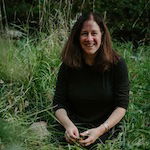
Amelia Zahm is the third place winner of Streetlight’s 2025 Essay/Memoir Contest

Long strides carry her forward. I hear joy, that annoying tone of cheerful morning people. Sharon’s joy vibrates from her chest and carries the lilt of her voice toward the sky. “What a day!” She bounces over the grass, her grin infectious as it widens across her freckled cheeks. She stops for a moment, cradling the black jumping saddle against her belly. The brilliant May sun glints from the round gold frame of her glasses as she tilts her face upward, eyes closed. She inhales deeply, filling lungs not yet touched by fluid with cool morning air. “Just radiant.”
“It is,” I say, clearly lacking the same enthusiasm. My eyes squint against the dust and fine white hairs floating from the brush moving across my mare’s long white back. I hate the spring shed. Walking behind her, I run my hand over strong, curving haunches. I watch Sharon heading toward the arena, her copper hair swinging below the collar of her denim shirt. I smile at her high-watered mom jeans and white ankle socks.
In the saddle she is neat, tidy, focused—fierce. She tucks in her collared shirt, wears a thin black belt around her clean tan breaches. Her half chaps don’t shine, but they lack the clumps of mud that mine show. I watch her warming up her young mare. Sharon rescued Isabeau from a Canadian breeding farm, one of the many programs that formulate the hormone-replacement drug premarin from the urine of pregnant mares. Like many foals produced at these PMU farms, Isabeau was bred for her mother’s hormones rather than her own performance.
Her conformation is unfortunate—short neck, crooked front leg and broad back—but her chest holds the heart of a champion. Sharon patiently guides her through walk, trot, canter, leg yield, shoulder in—the fundamental movements that build strength, suppleness and obedience. With strong legs and soft hands, Sharon encourages her to relax and open her stride. Isabeau complies, happy to please her rider.
My mare and I have our usual warm-up conversation—she stops and refuses to move. Despite her excellent breeding, straight legs, and exceptional talent, her mind belongs only to her. She throws her head to yank the reins from my hands. She kicks at my spur. She bucks when I reinforce my request with the whip. It takes me fifteen minutes to convince her that working is actually more fun than arguing. They say horses mirror their owners, and I remind myself that we both come from hardy German stock.
It’s about breathing really, riding. My breath, hers. The rhythm of oxygen moving in and out of our lungs in time with the gait—slow and soft, expanding and contracting with the four-beat walk. Moving and changing as we lift into a trot—two beats in, two beats out. And with the canter—one inhale and exhale per stride, her breath becoming a steady, three-beat, rolling vibration.
Relaxed, regular rhythm—the foundation of the training pyramid. Riding this way takes patience, consistency, discipline. You have to know when to give, know when to insist, and know when to just wait it out. I struggle with this every day I’m in the saddle. And yet, we find it. When I come back to the breath, to the place where we draw life in and release resistance out, where the pace of our breathing matches our pace around the ring, we come together. Relaxation. Rhythm. Partnership. Trust.
A small group of us trained together, braving snow, sleet, and cold temperatures to ready our horses for spring clinics and summer shows. We jumped every Saturday morning and did flatwork during the week. We scheduled regular visits with guest trainers. Nelson came in March, setting up complicated gymnastics and challenging us with big, wide jumps built from standards, poles, and hay bales. He returned in May to take us cross country schooling over logs and ditches, up and down banks, and galloping in the hay field.
Sharon led the way, experienced, brave, quiet. My stomach flipped and flopped and bile rose in my throat as I waited for my turn, wondering if my mare would stop or jump, or go and just keep going. Sharon rode forward, encouraging her mare, approaching each fence with quiet confidence. When Nelson looked at us and said, “Off you go,” I exhaled, fueled by adrenalin and dread. At the end of the round, successful or not, whether I was on the ground or in the saddle, Sharon’s voice sang encouragement. We ended each day with hugs and tears, giggling as we untacked our horses, brushed their sweaty coats, and rewarded them with treats.
Of the three days of competition, the cross-country phase is usually the most appealing to spectators and riders alike. It is the ultimate challenge to prepare a horse for this rigorous test. Unlike other sports, where only the human will and body are pitted against the clock, in eventing, two minds and bodies work as one.”
— United States Eventing Association
I was frustrated when Sharon pulled out of our July clinic and show because of a chest cold. ‘How bad could it be?’ I thought. We’d been conditioning for this all year. I went by myself, hoping she would change her mind and show up at the last minute. A week later her husband told me—not a chest cold. Not a virus. Fluid. Cancer. Ovarian.
“Refusal: A disobedience in which the horse resists going over the element.
Rider Fall: A competitor is considered to have fallen when he is separated from his horse in such a way as to
necessitate remounting or vaulting into the saddle. A fall results in elimination from the competition.”
—From the Unites States Eventing Association Rules
Relaxed, regular rhythm. Obedience. Submission. Give, take, give, take. Wait.
Wait.
Wait.
Breathe.
Last Thanksgiving, I cheered Sharon on as she trotted around the field with her family—sisters, nieces and nephews visiting from Portland and California. I sat on my tall mare and watched Sharon’s thin frame, bundled in sweaters, a vest and jacket. Chemo killed her appetite, and her body held little to insulate her from the cold. Her smile broadened across her face. Her freckled cheeks flushed from the chill. She looked radiant on her last ride.
Ride forward with balance and a steady pace. Know your distance to the jump and feel your stride, from six strides out. At four strides, don’t interfere. If you’re coming wrong, let your horse sort it out. Trust your schooling. Sit up, sit back, and don’t get in the way. Isabeau always added a half-stride—safe, smart. My mare leaves long—she knows her scope. Sharon was patient. I just hang on.
Her hand shook as it reached for mine. I squeezed, but not too tight. She adjusted her oxygen tube and tugged at the neck of her hospital gown, grimacing as she tried to sit up. I exhaled, waiting. Our eyes met, and we smiled. I leaned close. She spoke slowly, softly, taking time to search for her words. We talked about her new gelding, his natural jumping ability, his big stride. We talked about my mare and my young gelding—complicated and challenging in different, wonderful ways. We talked about Nelson, laughed at how he pushed us, inspired us, scared us, showed us what we could do. We planned to visit her horses. She hoped she had strength to brush them. “Next time, we’ll get together for something fun,” she whispered.
“The cross-country test takes place on the second day of competition. The object of this test is to prove the speed, endurance, and jumping ability of the horse over varied terrain and obstacles. In order to accomplish this task, the horse and rider must be at peak condition. The horse must be brave and obedient, and the rider must use knowledge of pace in order to expend only as much of the horse’s energy as necessary, if they expect to finish well.”
—From the United States Eventing Association
Her husband Paul wrote: “For years Sharon has attended many jumping clinics and is well known for showing her horse a new fence before jumping for the first time.
I think she’s doing that now. The approach to the fence is long and with a slight bend five strides out, footing is a bit uneven and the fence itself is airy, but the landing side is level with good footing and a straight line to the finish. She’s taking a good look and showing the fence to her best mount. When she’s ready, she’ll approach and be ready with all the aids, leg, seat, hands, voice and crop if necessary, but you can bet she’ll clear the fence in fine form.
And if her horse starts to rush the fence she’ll pull up, stop, circle back, adjust and go again. She’ll ride defensively, not back-door bandit, but not too forward either. It may be a new fence, but one she’s anticipated and even looked forward too, just didn’t think it would come so soon.
Sharon continues to sleep peacefully. Her breathing is a bit labored, and as I say she’s taking a good look at the final fence.”
Death in the spring makes no sense. Temperatures warm, days lengthen, flowers bloom. Leaves burst on trees and grass grows thick and tall. This is a time of birth, re-generation, renewal, not a time to say goodbye. Not a time to accept a reality that will never feel true. My Mom died in May, fifteen years ago. The 14th. The Friday before Mother’s Day. Sharon died on April 26, a weekend we traditionally devote to jumping our horses under Nelson’s guidance.
This year, I spent that Saturday morning riding with our friend Julie. She learned the ropes from Sharon, just like I did. As I cantered along the straight white fence, urging my mare forward, encouraging her to find a galloping stride, I felt the cool spring air and sunshine on my face. My vision softened, my chest tingled, and I could feel her. I felt Sharon right there with me, in my heart, in the rhythm of my ride and my life, smiling and laughing. I turned my face upward, welcoming the radiance of the April sun.
Warm breath slips from caverns that lie beneath her soft pink nose, and I inhale. A dark eye blinks slowly, white lashes winking, flirting, asking, with pricked ears: Treat? A shiny leather saddle, padded with white fleece, makes the perfect seat. Her attitude in the switch of her tail, the stomp of her hoof, a kick at my heel. Surrender as she starts to move, blowing out, stretching her neck. And the rhythm: my back moving with hers, our breathing synchronized, our eyes keen, trained on the fence ahead. Intent, in stride, balanced, focused. Four, three, two, one—we take flight.





Share this post with your friends.

