
Going to visit a dead body has seemed bizarre to me since my first such occasion when I was five or six years old. Like any good Southern family, we had seemingly countless numbers of old ladies populating the family tree. Most of them were a little scary, I thought. They were somebody’s second-cousin-twice-removed or a great-aunt or Neva’s mother-in-law, someone whose life and death had little bearing on my life. But Mom and Daddy took me with them to the funeral home for the Visitation, an occasion taken very seriously in my family. We would also go to the funeral the next day and to the dead person’s family home, and then we’d add their grave to our usual rounds on Memorial Day, Labor Day, Easter, and Christmas. Mom would cut flowers from her garden and put them in old mayonnaise jars with water. She balanced them in a box in the car’s trunk. The peonies in spring with their fluffy heads and bittersweet scent left a lot of petals on the trunk floor as we drove from Alexandria to Bladensburg, Maryland (a suburb of Washington, DC) where most of the old folks were buried at Cedar Hill Cemetery.
I loved this cemetery because it was like a park with ponds, an ornamental bridge over a creek, lots of trees, and ducks and geese. While Mom and Daddy transferred the home-grown flowers into the ugly brass vases provided by the cemetery, I would run around the graves and down to the pond to look at the birds. I wondered why my parents wanted to hang around each grave a while after the flowers were situated. I didn’t understand yet how sometimes we need to contemplate the mystery of a life that has ended, without words and even without the rituals of our church. I couldn’t possibly have grasped their silent graveside meditations.
Nor did I understand the whole funeral-home/dead-body visit. I remember being dressed up for the occasion and walking awkwardly in my slick-soled shoes. My dress, coat, and hat—you never go to a funeral home without a hat, you know—felt tight and hot the minute we were inside the place. If we’d been at somebody’s house, I could have taken the old coat and hat and shoes off and played with my cousins. But no, I had to act like I was in church, only really sad, too. The attitude fit me poorly.
We drove to my father’s cousin Billy’s funeral home in northeast Washington, D.C. Billy was a kind but subdued man whose manner matched the hush of the place. After Billy greeted us, my parents signed a book. (Was this like answering “here” to the teacher’s roll call? I didn’t know.) We went into a big room with soft lighting that glowed pale pink. Many dressed-up relatives were there. Ladies had tissues in their hands to wipe away tears, even if the deceased was ninety-five and had been declining for years and nobody really liked her anyway. People suppressed their voices and mostly ignored any child who came along, except for my Uncle Jimmy, who had shell shock and a profound hearing loss from being at Pearl Harbor on December 7, 1941. Since he couldn’t hear, he didn’t know he was really loud. He also swore a lot. He came up to me and shouted, “Well, how you doin’, Miss Nonnie Lee?” (Only he called me that; it’s a variation on my real name in the family, which was Connie Lee.) I liked him a lot in situations like this. He broke up the boredom and scandalized the aunts, because one thing you do not do at a Visitation is to shout.
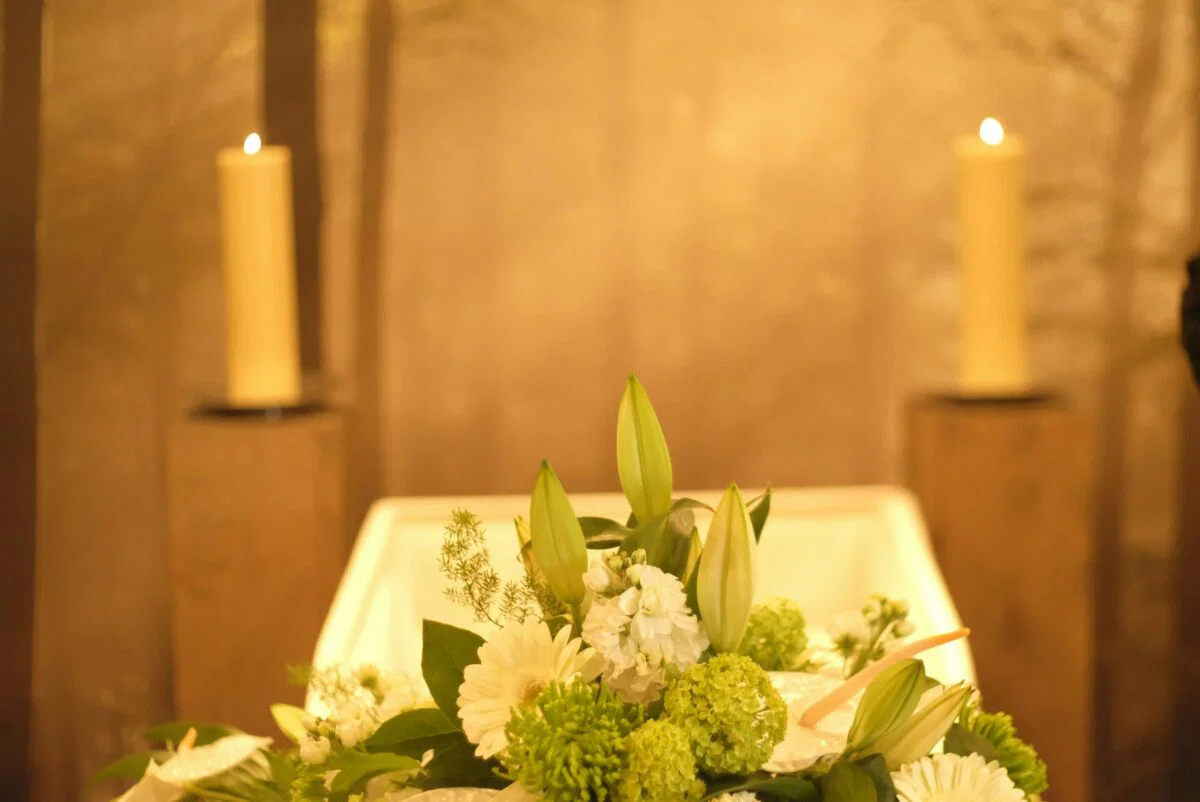
I noticed a giant box with its top open and a white, shiny lining. Beside it were stands, shaped like easels, with flower arrangements on them like a big rack of trophies surrounding the winning horse after a race. I couldn’t see from where I stood what was inside the box, but people were clustered around it whispering, and the ladies dabbed their eyes.
A kneeler had been placed just in front of the big box. I knew what a kneeler was because we had them in church. I watched as one of the aunts went up and knelt down. First she looked inside the box, then she dabbed her eyes again, then she bowed her head and crossed herself (some members of the family were Roman Catholic). She got up and looked for her husband, who stepped forward to offer his arm and comfort.
I still didn’t know what was in the box, but I was beginning to wonder if it was her, the old lady who had died. I wondered if I would have to kneel there and look at her and say a prayer. The heavy smell of carnations nearly gagged me and my shoes pinched my heels. I wondered if I could get lost in the crowd until Mom and Daddy were ready to leave, but no, here came Mom.
“Come on, honey, come up with me and we’ll look at Aunt Ada [or whoever it was this time] and say a prayer,” she said, stretching out her hand. Seeing no way to escape now, I went forward with her, but someone else got there first. This lady not only knelt, looked, and prayed, but also, on getting up, reached over into the box and kissed what I was guessing was the face of Aunt Ada.
I was NOT going to do that. I hated kissing all the old ladies while they were alive, and I certainly didn’t intend to kiss a dead one!
“Mom,” I whispered urgently, tugging on her hand, “do I have to kiss her?”
“No,” she said, “just kneel with me and say a prayer.”
So we knelt. I could barely peer into the box, but I clearly saw an old lady in a nightgown with her hands crossed at her waist. She looked terrible; that was to be expected with old ladies, in my experience. But there was something really weird about her, too. She didn’t move at all, not even to breathe. I didn’t remember ever seeing her before, but I said “Come let us sing unto the Lord,” the first line of one of the canticles we sang in church most weeks and the first line of Psalm 95, because I couldn’t think of anything else, and got up when Mom got up, I hoped that would be the end of it.
Happily, Daddy had already done his duty and he was ready to go, hat in hand. I might not have known the word “duty” at that point, I might not have grasped the concept of death (who ever does?), but one thing’s for sure: I knew I didn’t want to be in the room with that weird-looking lady in the big box for another minute.
We stepped out into a winter night. I inhaled the smells of leaf mold and wood smoke, and as those slick soles hit the brick sidewalk, I wanted to run, not walk, to our waiting car. When we got home, I would lie on the floor with my dog Pete beside the oil stove vent. His smell would take away the saccharine smell of funeral flowers, his soft brown coat would soothe me, and the stove’s intense heat would blow away, I hoped, the chill I felt, which had little to do with the weather.




Share this post with your friends.


Connie, don’t forget me if you need a recovered crazy to tell you about life in a state hospital.