
A ten foot giraffe. A ballerina on tiptoe. A gyrating rocker. The Angel Gabriel and an Artist in the Time of Covid. These are but a few of the playful and thought-provoking metal sculptures by New England artist Madeleine Lord.
Lord remembers how her love of sculptures began. “In 1983 a widowed friend with poor eyesight wanted to attend the night welding class at the technical high school and needed a driver. I wanted to learn to weld so off we went.”
She was hooked, accustomed to creating paintings and woodcut prints. “Welded scrap metal was cheaper than art supplies. The Mobil station owner let me use his equipment at night until his insurance agent filled up and saw me. A local metal shop adopted me, welded a table for my height and I spent hours there while the children were in school.”
Lord started cutting drawings in metal, not unlike the woodcut prints she had been making. “I also worked up the courage to weld and with found scraps from a dump in Readeville, Mass. created the 3D works I still make today,” she says. The scraps imply the future sculptures as they are transformed into animals, florals, figures and abstracts.
“I am completely at the mercy of the mashed bent scraps I can carry to my car in a metal yard that allows me to scavenge on Saturday mornings. The mountains of steel detritus are chewed up by their machines which sort and move it from the trucks which bring it in. I look for interesting curves, shapes and sizes, limbs, heads, joiners, colorful peeling pieces. I bring them home and sort them out on the driveway. I live at the top of a long hill, no neighbors in sight so I can make a mess and work with noisy tools without bothering anyone,” she says.
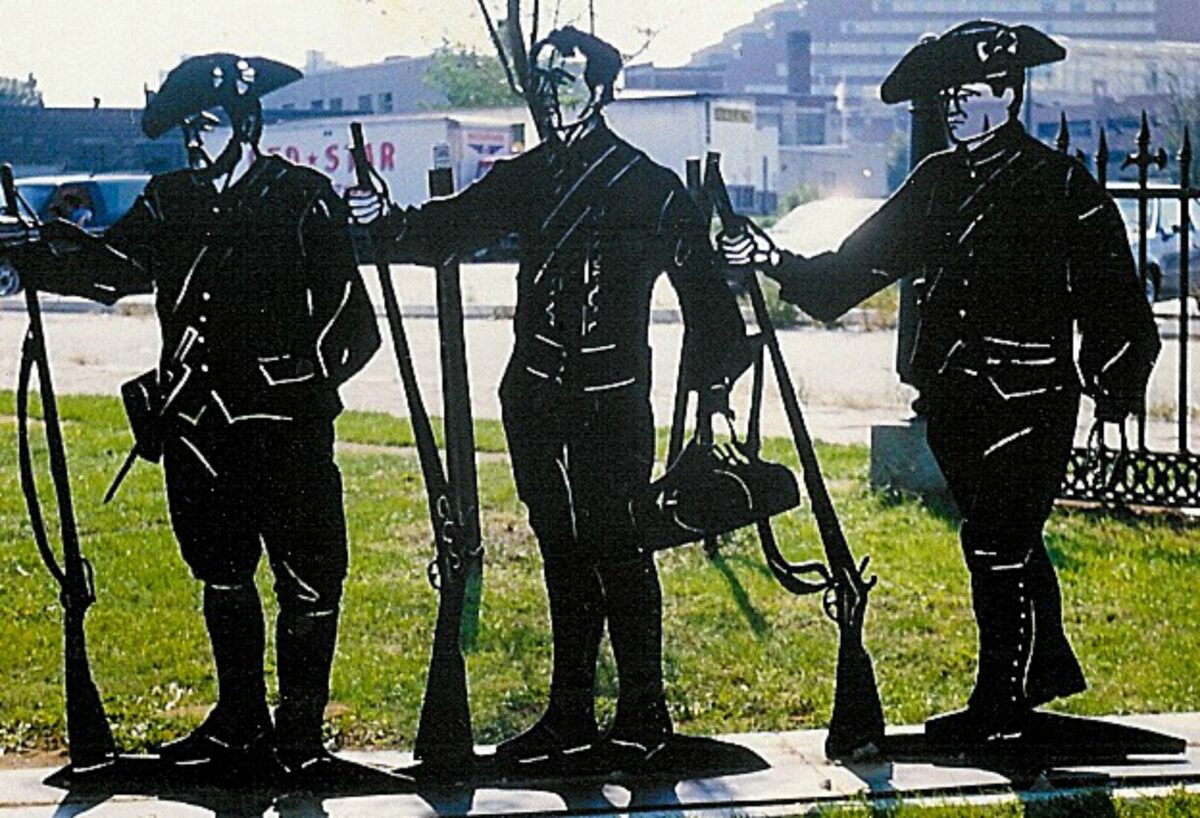
Lord is particularly drawn to the fact that metal sculptures stand up on their own. In 1987, her first public work was cut out life-size Minutemen figures (above) for Fort Washington Park in Cambridge, Mass. Many of her friends were Revolutionary War re-enactors, so these were portraits of them.
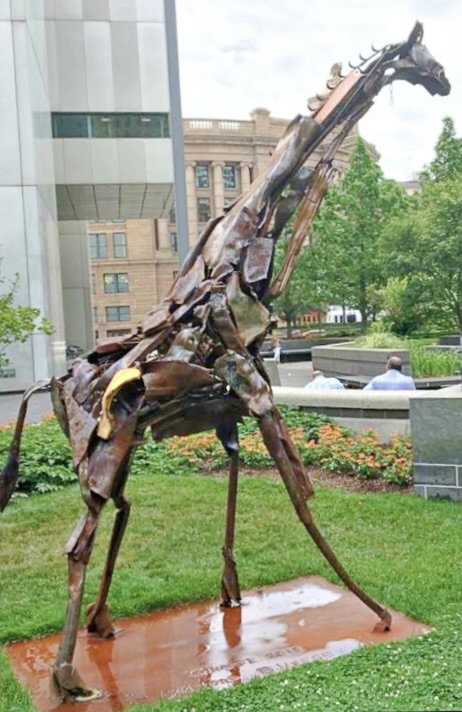
Over the last thirty years, blowtorch in hand, Lord has created an intriguing body of work, big and small. Her largest public piece includes a ten foot tall giraffe, purchased by the Boston Federal Reserve Bank in 2015. It is composed of many scraps from the Big Dig which took place in front of the bank.
The Giraffe started with parts that formed the head, and that defined the scale of the rest of it, Lord says. “It was created while I lived in a tight neighborhood, Winchester, Mass., so neighbors watched each addition. Carting it out of the driveway was an engineering feat managed by a good friend. I worked at the Federal Reserve Bank and was a friend of the woman who bought regional art for their collection. One day after I had moved on she called and asked if I had ‘anything big.’”
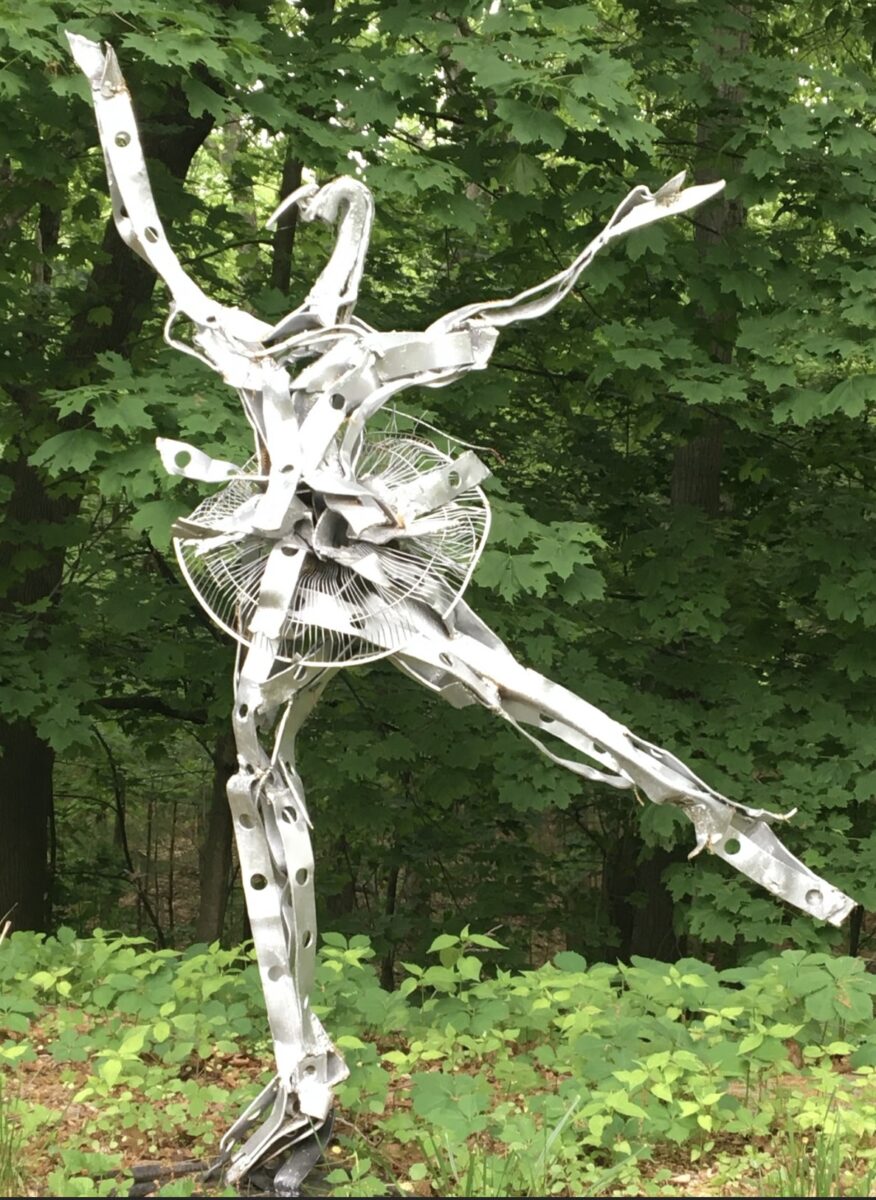
In Swan Lake, 2017, Lord found a large pile of twisted galvanized strips and an antique fridge opener which looked like a swan’s beak. She thought the fan frame tutu was the right scale for Swan Lake. “I loved the story where a princess is turned into a swan by an evil sorcerer, but given a webbed swan foot I was able to make the dancer stand up with a strong base,” she says.
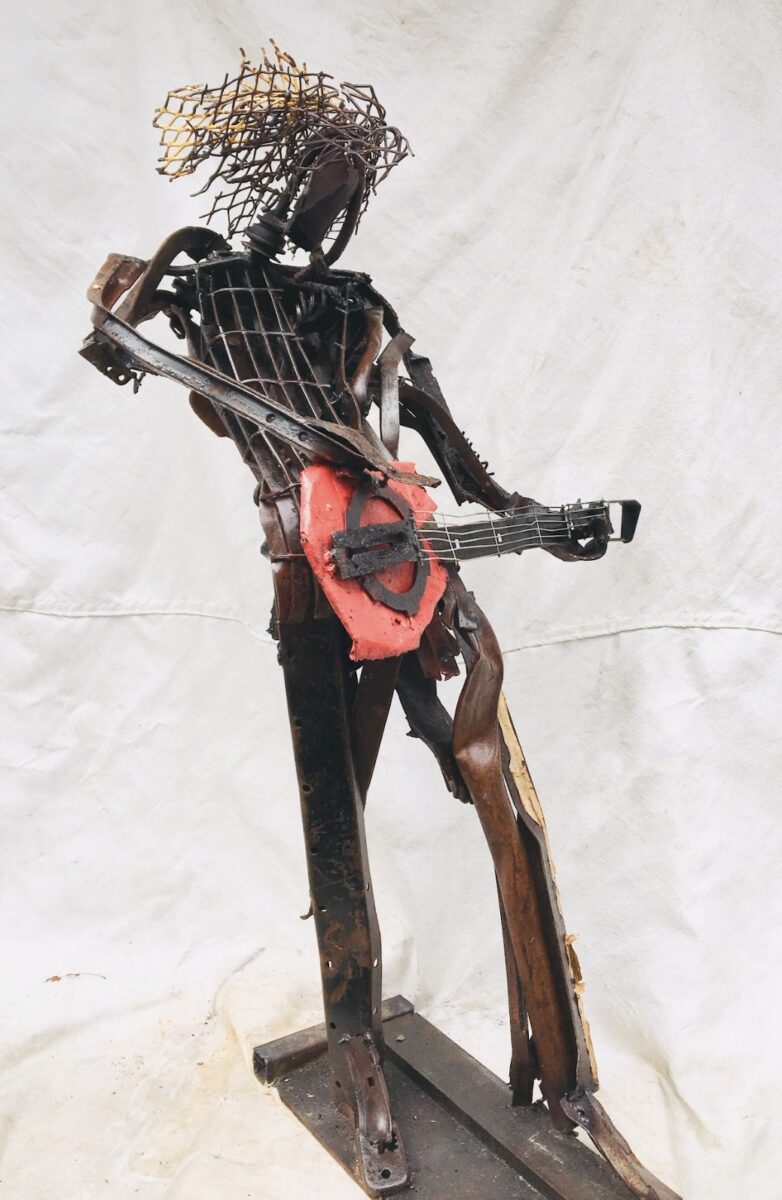
Working on the Rocker from 2016-2020, Lord says “It started out very thin, like a work by Alberto Giacometti. The posture, bass guitar and hair were inspired by my son in his high school band. My grandson has the wild hair and had a brief love of the guitar. The scrap that formed the guitar determined the scale. Over three years his flying hair and muscular arms built up with scraps that fit and I would add on. He now plays every day at the entrance to a bar in a Worcester marketplace.”
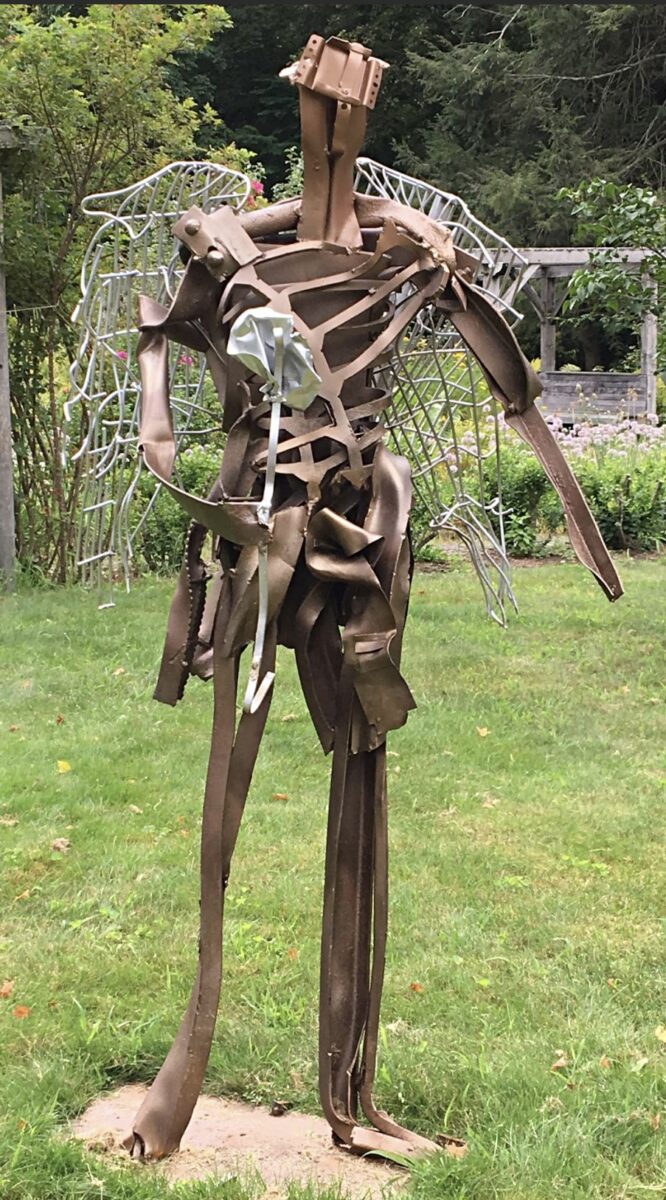
At the other end of the spectrum is Lord’s Angel Gabriel. The work started with a metal scrap that looked like a lily and a visit to the Russian Icon Museum in Clinton, Mass. The exhibit was based on the Annunciation, when Angel Gabriel visited the virgin Mary to relay the news of her impending son—from God, she explains. Gabriel was an archangel who helped drive Satan to Hell when there was an early schism in heaven. Thus the warrior gear and extended arm with a lily.
Many of Lord’s more recent figures have taken a personal and political turn. Some are in a group called “Talking Back to the News.” “Without exception, she says, “I think each piece is a prayer, honoring empathy, beauty, creation, or illustrating the lack of these things.”
She admires the works of Rodin’s Les Bourgeois de Calais and his Balzac portraits that are “in motion, beautiful 3D drawings, raw and deeply emotional. I work for those attributes with my welded scraps,” she says.
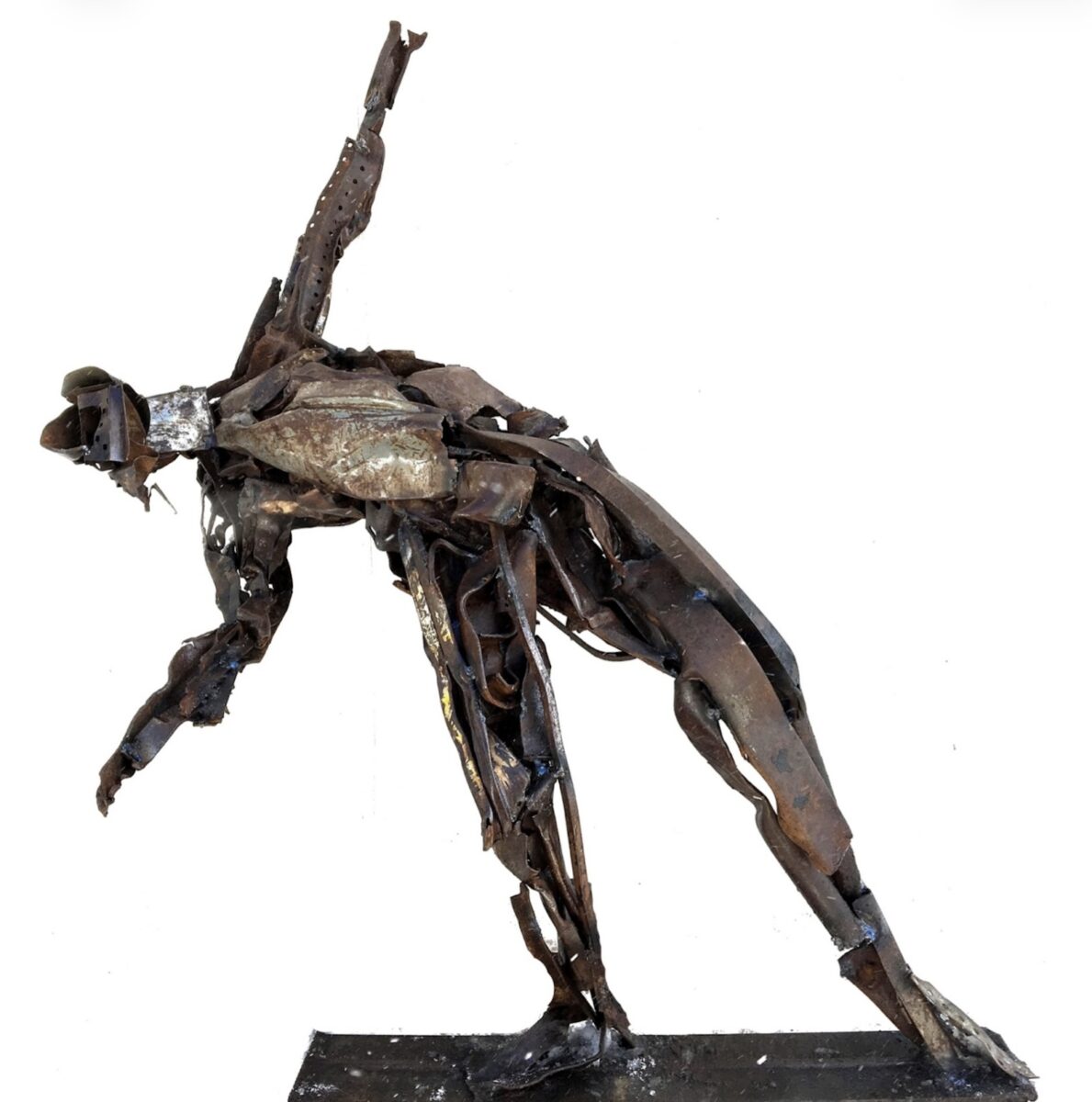
Grief, she says ”appeared in the scraps after my parents died and my son ran away. It was an impossibly sad time for me. Gravity eventually pulled the piece down. I rebuilt it to a more ’surfer’ like stance and it now greets visitors at the Lexington, Mass. Arts and Crafts center with the new name: Exhale.”
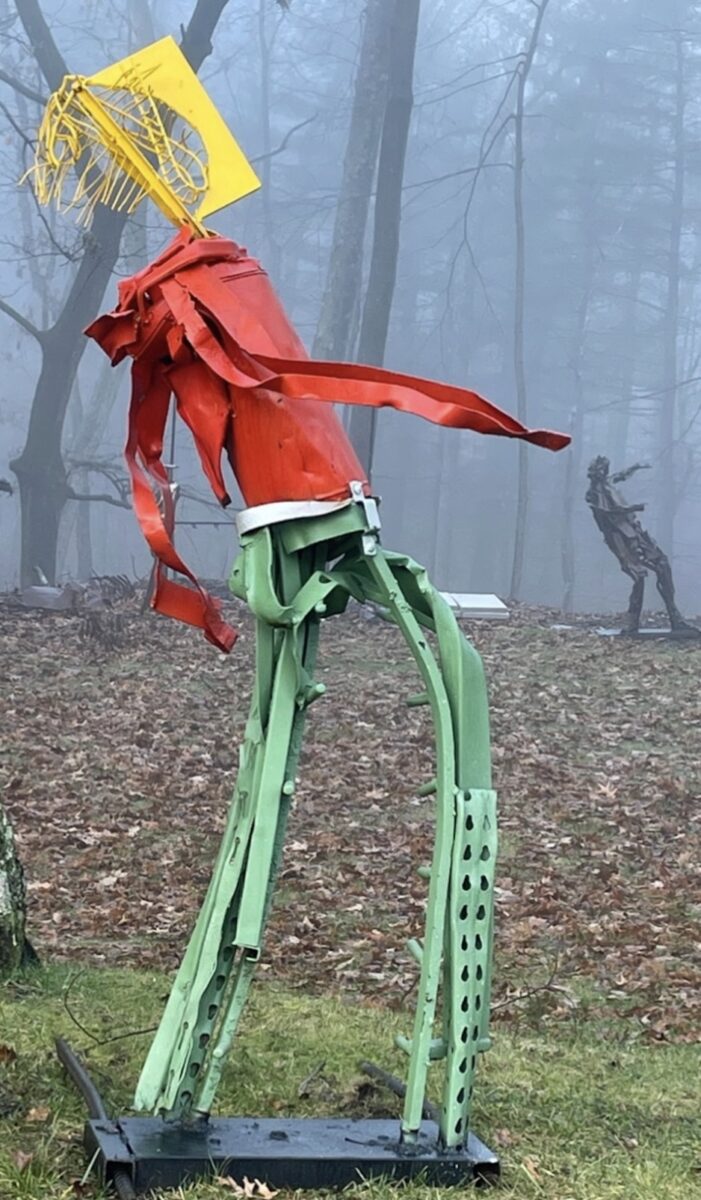
Onward was dedicated to the high school students who fought for gun laws after the shootings and deaths at Lakeland, Fla. “I started with the half moon cutout head; the tin that forms the sweatshirt and long articulated legs. I used the crushed potato chip can as the hoodie and a base color. Then it was composed to be colors that I hoped would not be gender specific but a purposeful and hopeful contemporary high school figure,” she says. It was purchased by MIT in Cambridge, Mass.
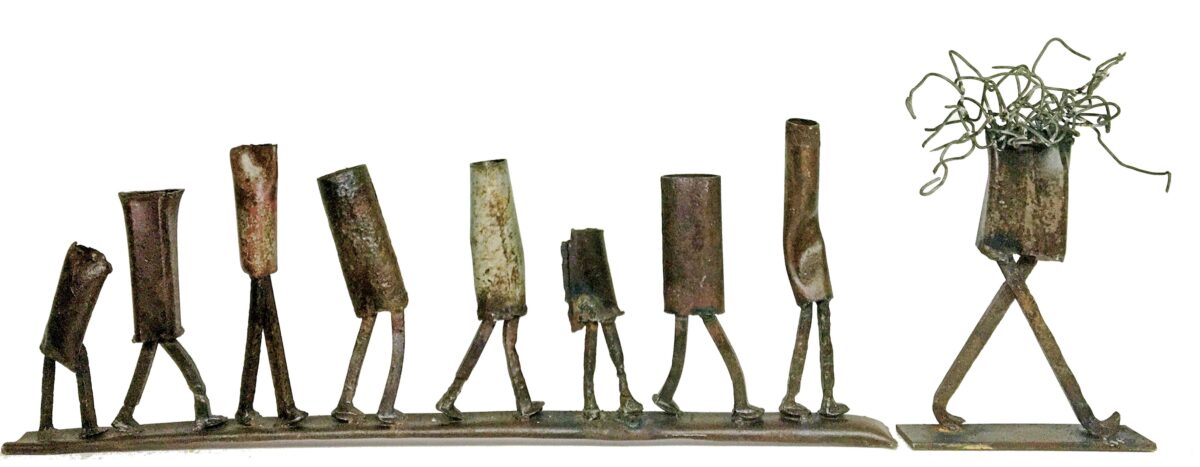
For Follow the Leader, Lord unearthed all the dented pipe sections in this parade on a single visit to the metal dump.The legs also were rare bent railroad nails.”The scraps were telling me to make this, the mindless parade behind a mad leader,” she says.
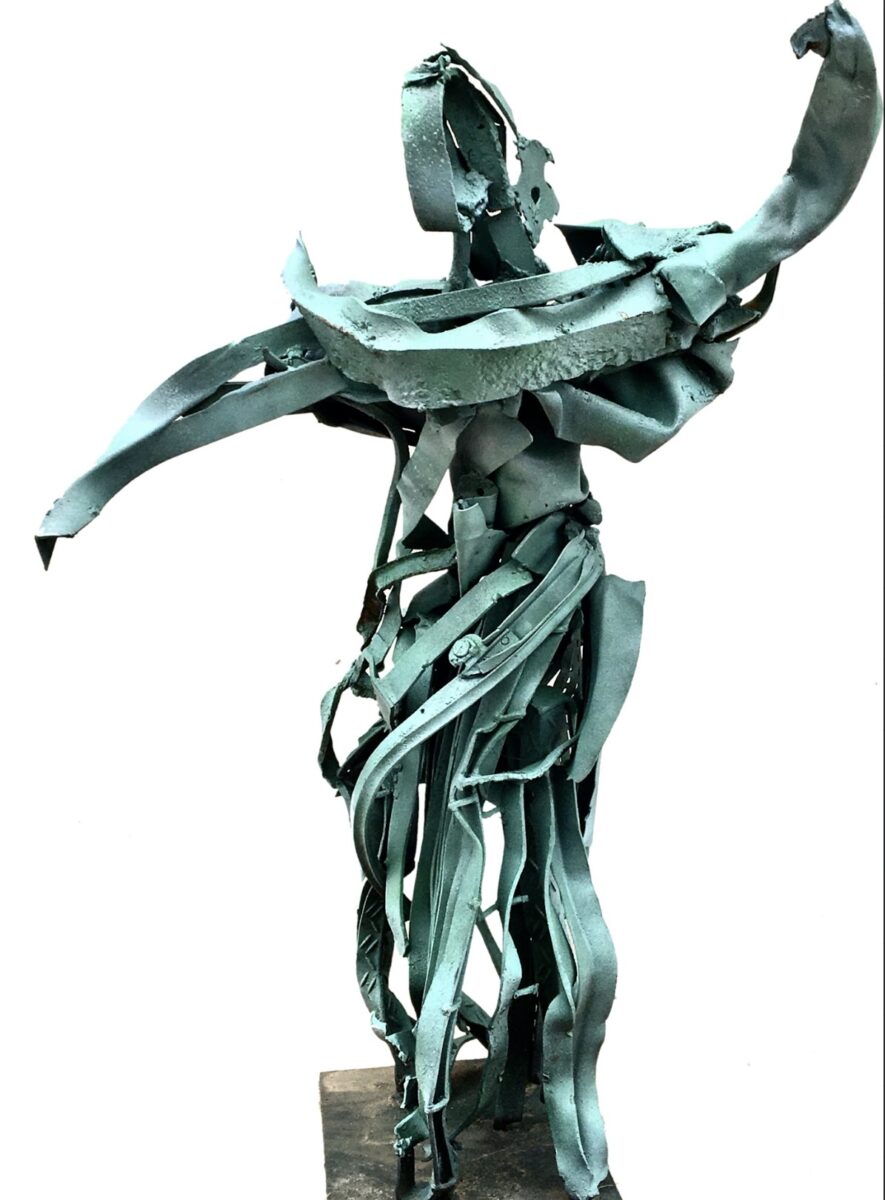
“The Women are Coming is an homage to the outspoken women journalists, candidates and those serving Congress and Senators at that time,” she says. “It’s a riff on Joan of Arc and classic women heroines.”
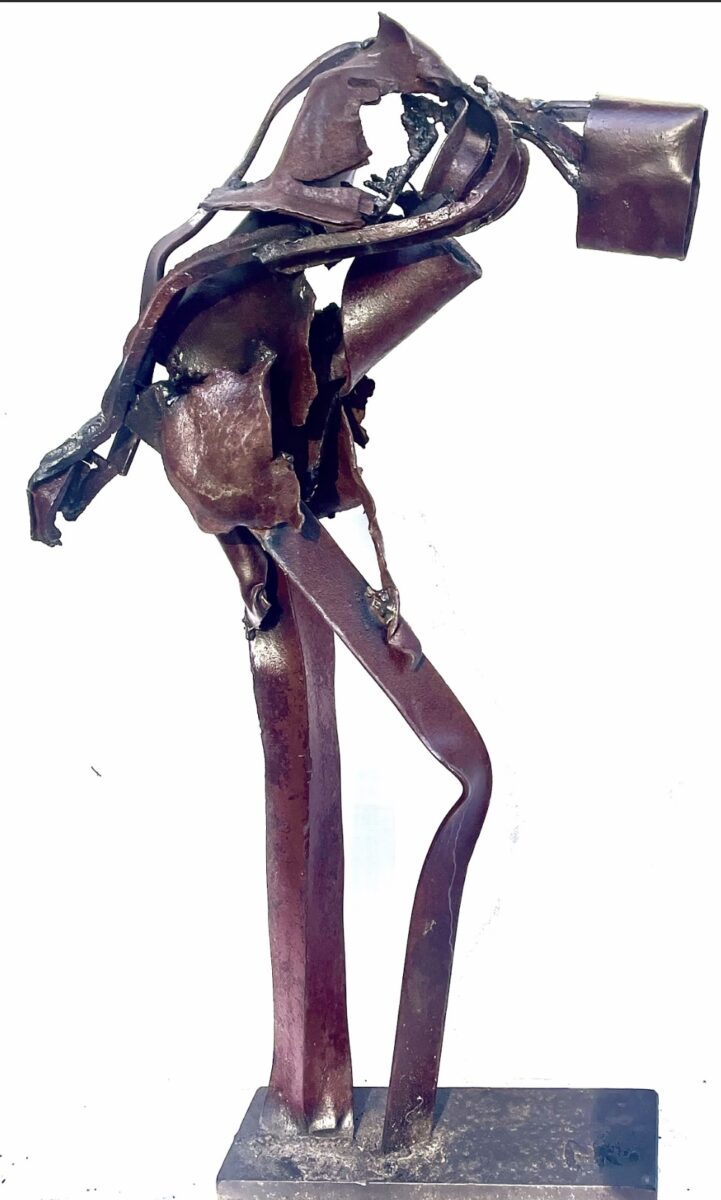
Detainee is one of five works where, she says, “I had in mind the boat people in the Mediterranean dying at sea or in camps in Italy or Greece, exiles from North Africa, Turkey and eventually Ukraine. Then Central and South America, they all broke my heart. The scraps kept me creating faceless wanderers, at great loss but great hope at the same time. The figure is clearly miserable, yet with one foot in front of the other, walking through the pain.”
During Covid the metal yards were closed for several years so Lord welded sculptures that were increasingly abstract as her scraps dwindled. Pieces where form, color and an integrated whole were the result.
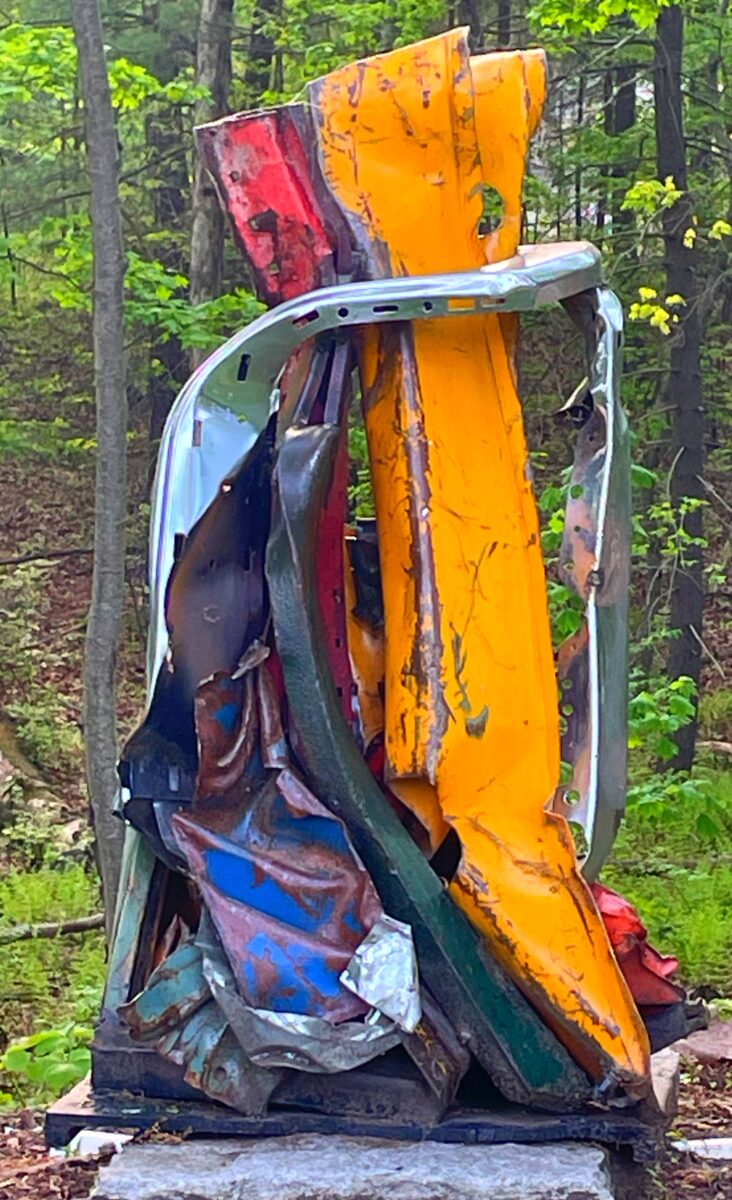
Old Friends was among the first abstracts made during Covid. “A childhood friend from Manhattan lived in my Dudley Mass. home as he was panicked about the Covid virus spreading. He was the Old Friend which implies a hug in the way the chrome piece wraps around the yellow, red and green vertical scraps. Hugs were forbidden during Covid,” she notes.
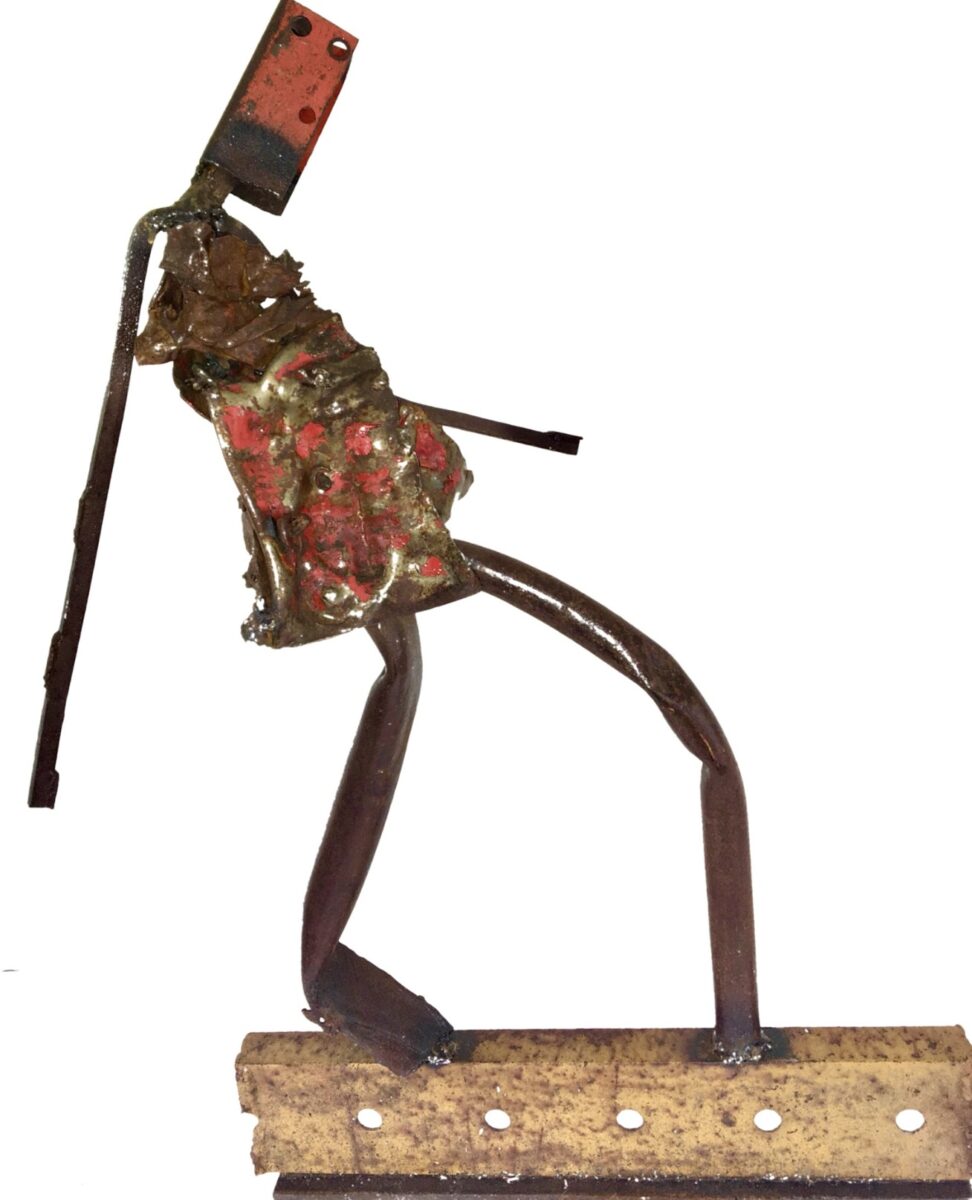
“This profile figure steps gingerly out of masked sequestration into an unknown future,” says Lord.
“Sculptor Magdalena Abakanowicz’s figurative works may be headless or armless, like pillaged Roman sculptures. That gave me permission to omit those limbs if there were no scraps to make them.
“I have found that viewers like the illusion of a figure, animal or flower, or if abstract, they enjoy wondering what all the parts used to be.’
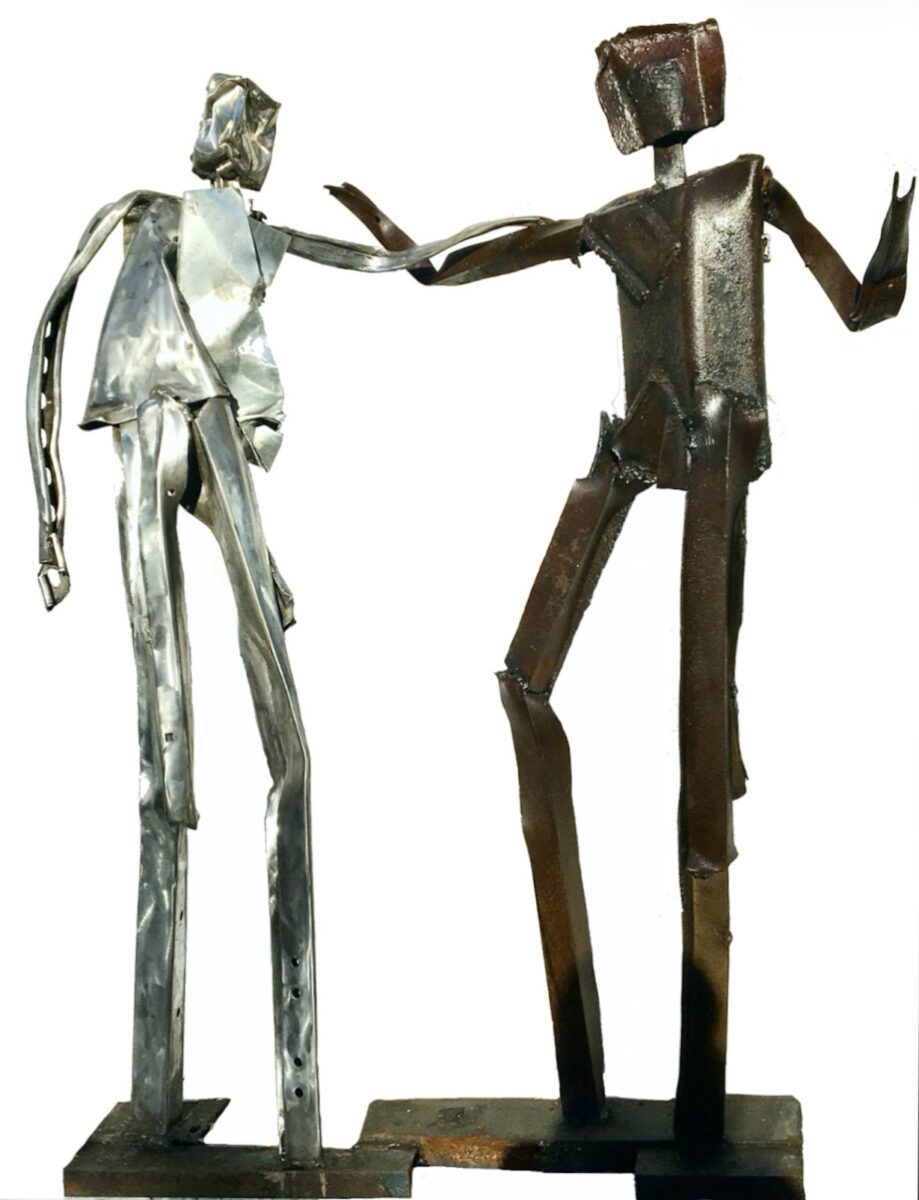
Let’s Figure it Out was created with two figures and welded to a base back to back. “The humanist. non humanist divide at that time in our country was so palpable and we had no idea how deep the trench would become,” she says.
“I later placed the heads face to face and arms reaching towards each other. I retitled it. My hope is for better outcomes, more cohesion to the greater good is under daily onslaught. So I express my hopes in visual prayers.
“Works like Onward and Let’s Figure it Out help me believe in these things. Without being preachy I want the art to inspire, uplift, entertain even so viewers who may not know each other or even agree on much can share a similar moment.”




Share this post with your friends.

