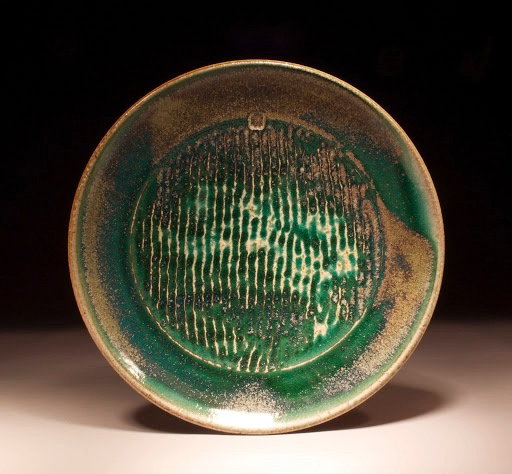
A lovely bowl incorporates Jarvis’s trademark impressed-rope pattern, emphasized by an artfully applied green glaze.
Ceramic artist Judd Jarvis finds a thoughtful middle ground between form and function.
It’s tempting to suggest that Virginia’s famous red clay soil lured potter Judd Jarvis from the Midwest’s dark earth to Charlottesville. Jarvis’s ceramic artistry is far removed, though, from the utilitarian brick that surrounds us, and even a far cry from the negative-space narratives of ancient Greek red-figure pottery. His work is proof that ceramics, despite the simple functionality that so many people expect of it, is art for art’s sake in the right hands.
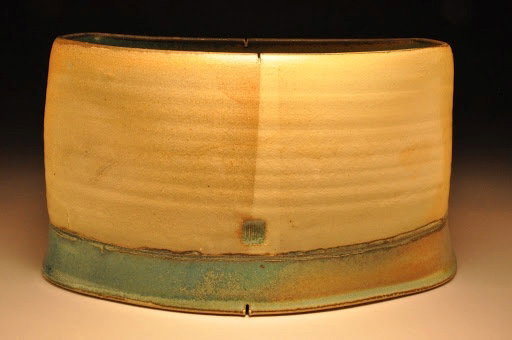
A flattened vase is stamped with a purely decorative Chinese “chop” that suggests the cornstalks of Jarvis’s native Iowa. The artist describes it as a visual exclamation point.
“I used to be more hung up on whether I made something for an actual use. I worried, would it work for that purpose?” says Jarvis. “But do you really need to drink coffee out of it? I’m just not very dogmatic about ceramics any more.” Then why use clay at all? “Aside from being pretty common on this planet, clay has unique properties. I love its tactile qualities. I can mold it or carve it. I can work in an additive way, building it up. I can work in a subtractive way, taking away from it. And however I work, I can make it permanent by firing it.” All that said, Jarvis isn’t wedded to techniques that are idiosyncratic to ceramics. “I don’t care what your process is if it gives you the surface and the look and other qualities you want. I’m fine with bisque-firing a piece then dipping it in house paint, if that’s what it takes.”
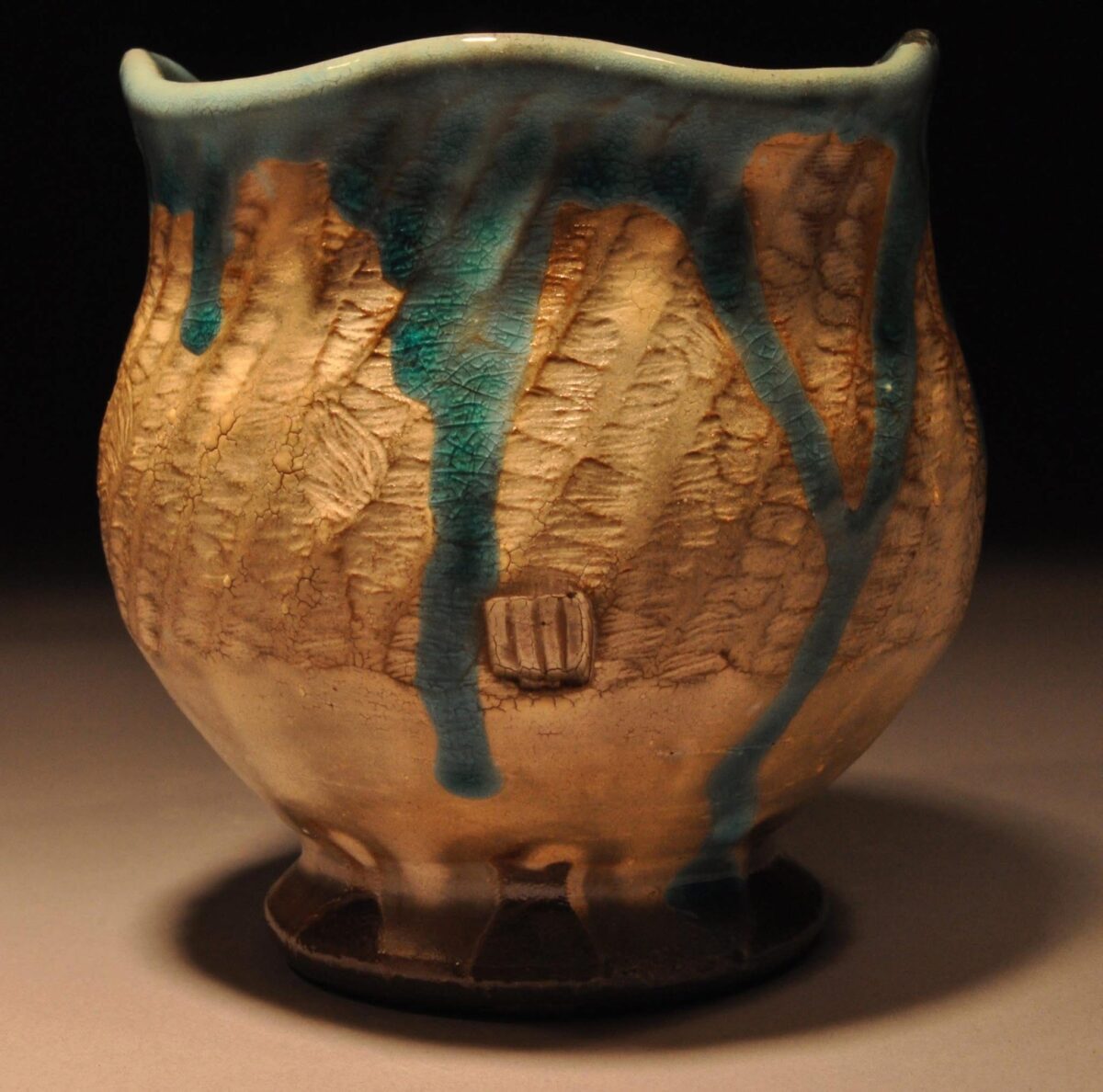
Green glaze flows down the side of a yunomi, a traditional Japanese handleless teacup for daily rather than ceremonial use. Note Jarvis’s use of the rope pattern at a diagonal.
As part of his rejection of ceramics orthodoxy, Jarvis often leaves evidence of his craft in his pieces. “I tend not to be shy about showing how stuff is made,” he explains. “If there’s a seam in a clay piece I might keep it visible, or even accentuate it.” Yet he attaches no higher meaning to process itself. Take the wood kiln, which is heated by wood that causes ash and vaporized minerals to be deposited on the ceramics within, creating unusual colors and patterns in the finished work. “I love wood kilns, and they’re an amazing tool that you can do great things with,” he says. “But they’re like a really useful paintbrush. I don’t have the kind of spiritual connection with them, or with other processes like raku firing, that some ceramics people seem to have. They’re just another tool that aligns with what you’re trying to do aesthetically. Atmospheric kilns, whether wood or salt or soda, don’t make content.”
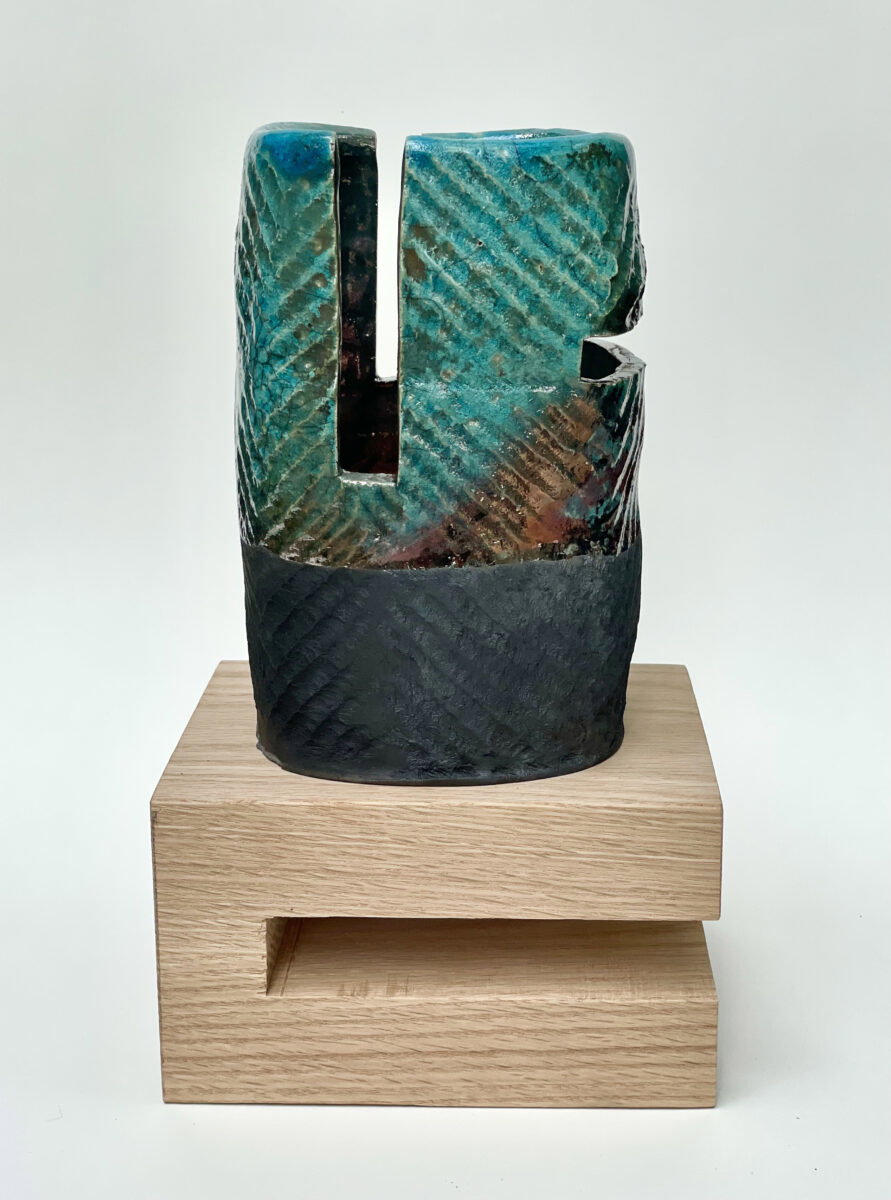
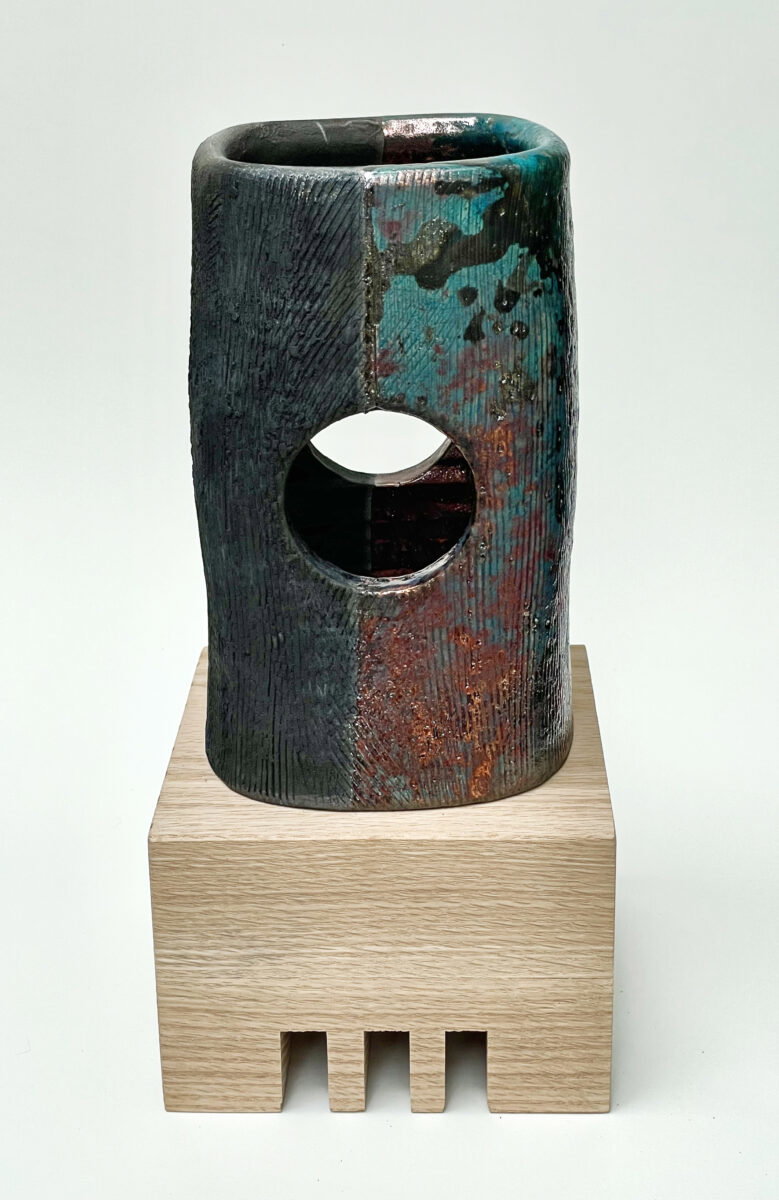
Jarvis’s newer ceramic work often echoes the techniques of woodworking, such as in the sharp, 90-degree cutouts of this piece.
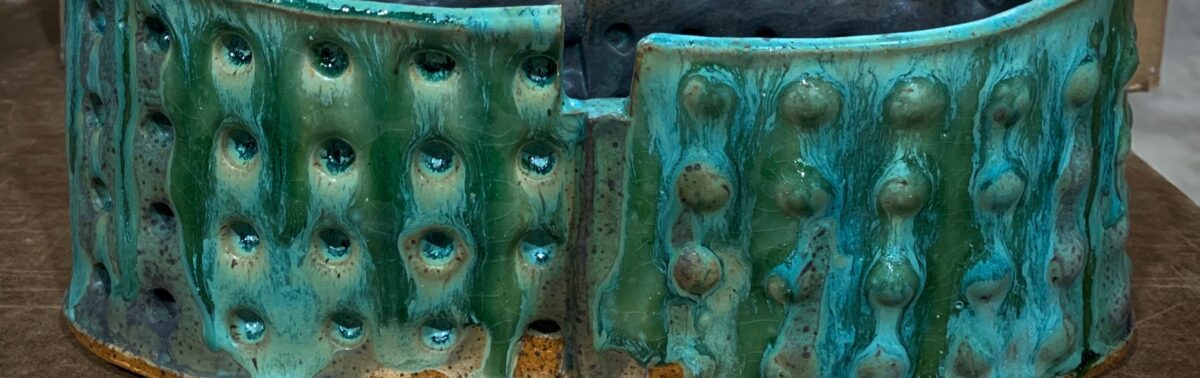
In fact Jarvis’s work sometimes alludes to other materials. Recent pieces feature angular cutouts and holes in the clay that evoke the techniques of woodworking, a craft in which he’s highly experienced. He even presses clay into pegboard, the familiar perforated Masonite that keeps workshop tools organized, to create a grid of bumps reminiscent of the protrusions on ancient Chinese bronze bells.
Many other pieces feature a pattern created by Jarvis’s pressing rope into the clay’s surface before the firing. This treatment makes an interesting historical reference to basketry, which predates the advent of pottery by thousands of years. At some point early craftspeople realized that applying clay to the interior of a basket— itself often made by coiling a continuous length of woven rope— improved its watertightness. Then, perhaps by accident, they discovered that you could burn off the woven material in a fire and, provided the clay was thick enough to support itself, be left with a clay vessel.
This recent piece offers a wry comment on pottery’s expected functionality. It’s not only open at the top and bottom, but also has round holes cut in it— all making it incapable of holding a liquid.
The pattern of the rope or other weaving would be left on the exterior of such a clay vessel, and some of Jarvis’s rope-textured work is exactly that, the impression of a rope encircling the outside surface of a piece. Even more surprising, though, are pieces that transpose this idea, in which rope is applied to the interior surface. Yet having a pronounced texture in the interior of a bowl or plate limits functionality: Such work takes a utilitarian idea and aestheticizes it, making it the nascent structure for a work of art.
Jarvis sometimes presses clay into pegboard to produce an ornamental grid of bumps, as shown in this detail; the bumps are also meant to disrupt glaze as it flows down the side of a piece. The combination of the bumps and the glaze’s blue-green evoke the traditional design of oxidized Chinese bronze bells.
Jarvis started life in a musical family, and was headed in that direction when a high-school elective art class introduced him to more concrete forms of expression. He was lucky that Indian Hills Community College in his hometown of Ottumwa, Iowa, had a good art program. One of its teachers even had a ceramics background. “I also took drawing, painting, and art history surveys, and I got hooked,” he says. “But I was tired of Midwestern winters.” Jarvis transferred way south, to the University of Miami, which leapt at the chance to bring in a ceramics major.
Jarvis ended up sharing studio space with an artist-in-residence, a “very functional” potter, who invited him to be his assistant for classes he was teaching at North Carolina’s Penland School of Craft. While there, he applied to graduate schools and went straight to the ceramics MFA program at the University of Nebraska in Lincoln, one of the largest in the country. Family connections, including a brother who was moving to Virginia, finally brought him to our area, around 2004. After living in Ivy and Afton, in 2021 Jarvis moved to Charlottesville, where he met and married photographer Cary Oliva.
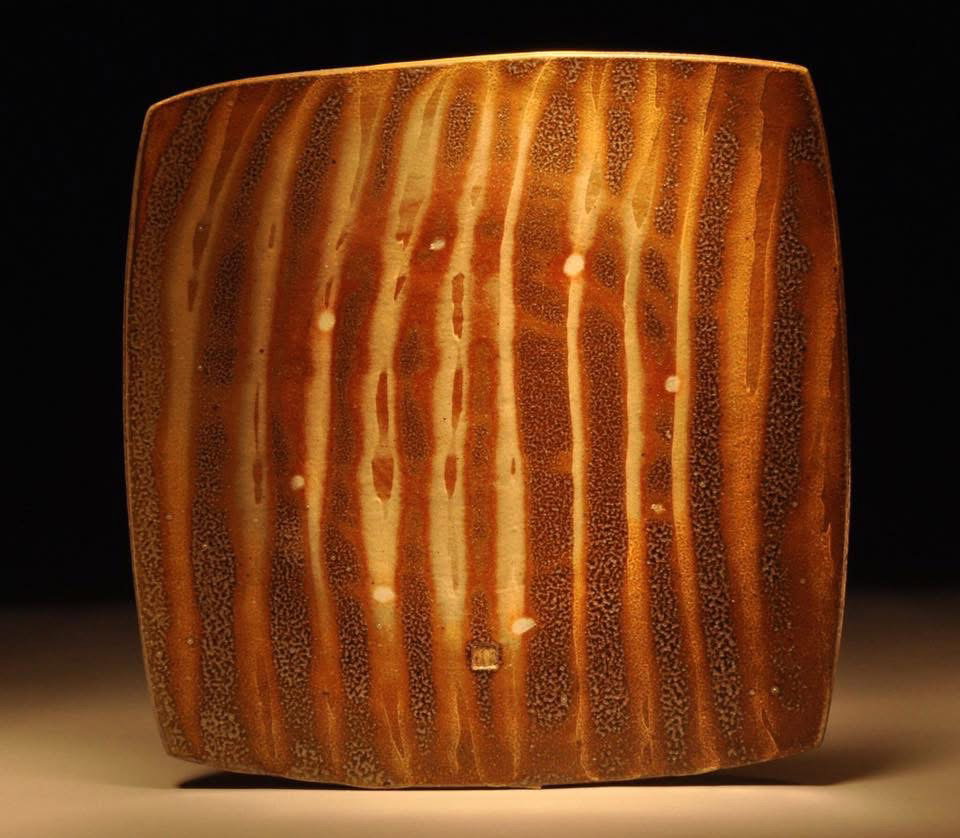
The stripes on this soda-fired square platter were achieved by applying slip that Jarvis then wiped away to create a pattern. The “orange peel” texture of the darker stripes is caused by the sodium eating into the clay’s surface.
Jarvis quickly made himself useful in the area’s artistic community. He joined the long-running Artisans Studio Tour and built kilns for other potters, a trade he learned in graduate school when his ceramics department had to set up shop in new quarters. He began teaching at Charlottesville’s enduring City Clay, continuing there for nearly fifteen years. And he did the arts festival circuit, though not with great enthusiasm. All that work was wedged into the demands of his day job, running the shop at Ivy’s Savvy Rest, a specialty mattress and bed-maker. Jarvis still works there, and has not only brought the company’s wooden bed-making in-house but has also designed and redesigned much of the line. “I think what I learned from the basic design courses I took in school, including drafting, is still in my brain,” he says. “Plus I had a grandfather who did woodworking.”
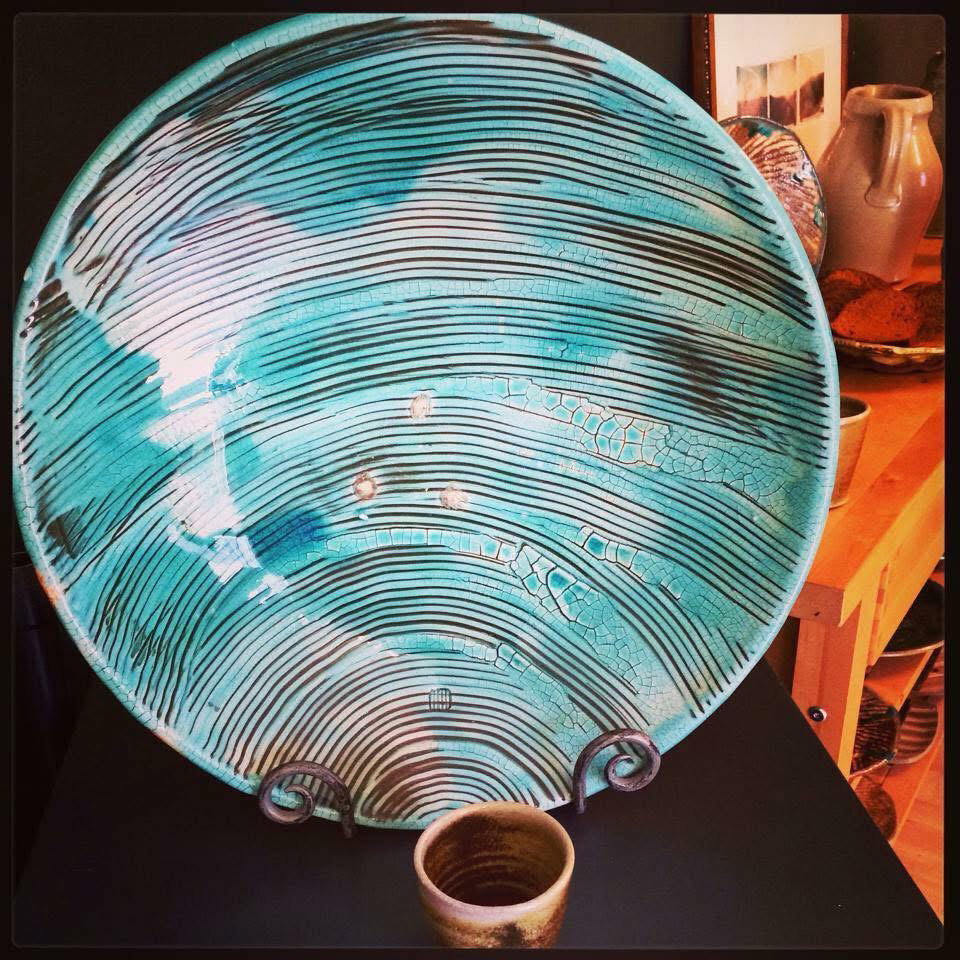
This bowl is meant to evoke the patterns of ocean shells with the turquoise of sunlit water and waves. Jarvis created the scoring by applying thick slip to the bowl then running a tool across it.
The artist’s experience with wood, a far less pliant material than clay, has influenced the way he pursues his ceramics. “There are a lot of strictures with working in wood, and unlike ceramics it’s fairly rectilinear,” he explains. “Yet it’s not unlike dealing with the parameters of functional ceramics. You have to get creative, and sometimes push the envelope of the material, to make things happen.” Indeed, some of Jarvis’s recent nonfunctional pieces include wooden bases, or are even made entirely of wood.
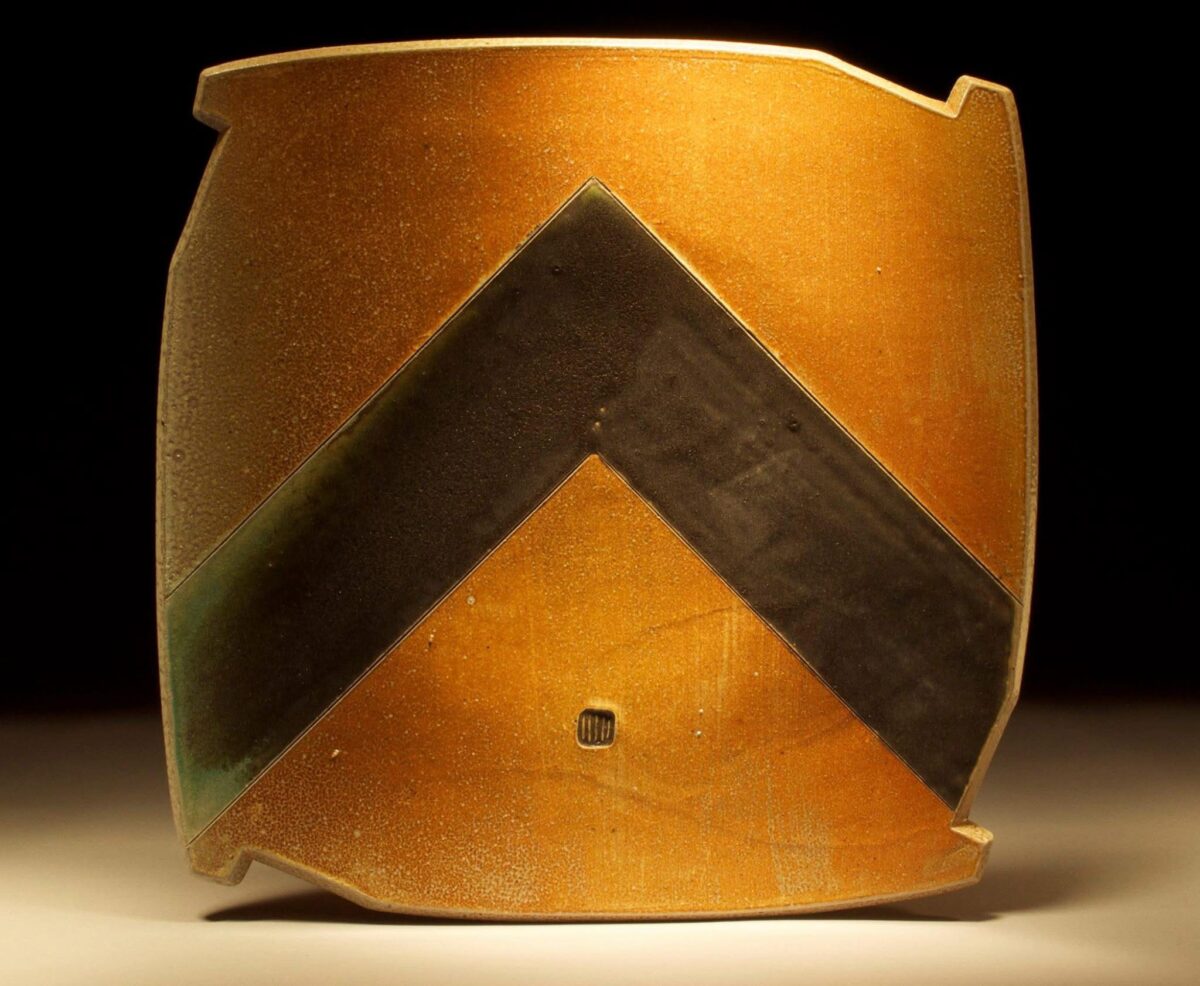
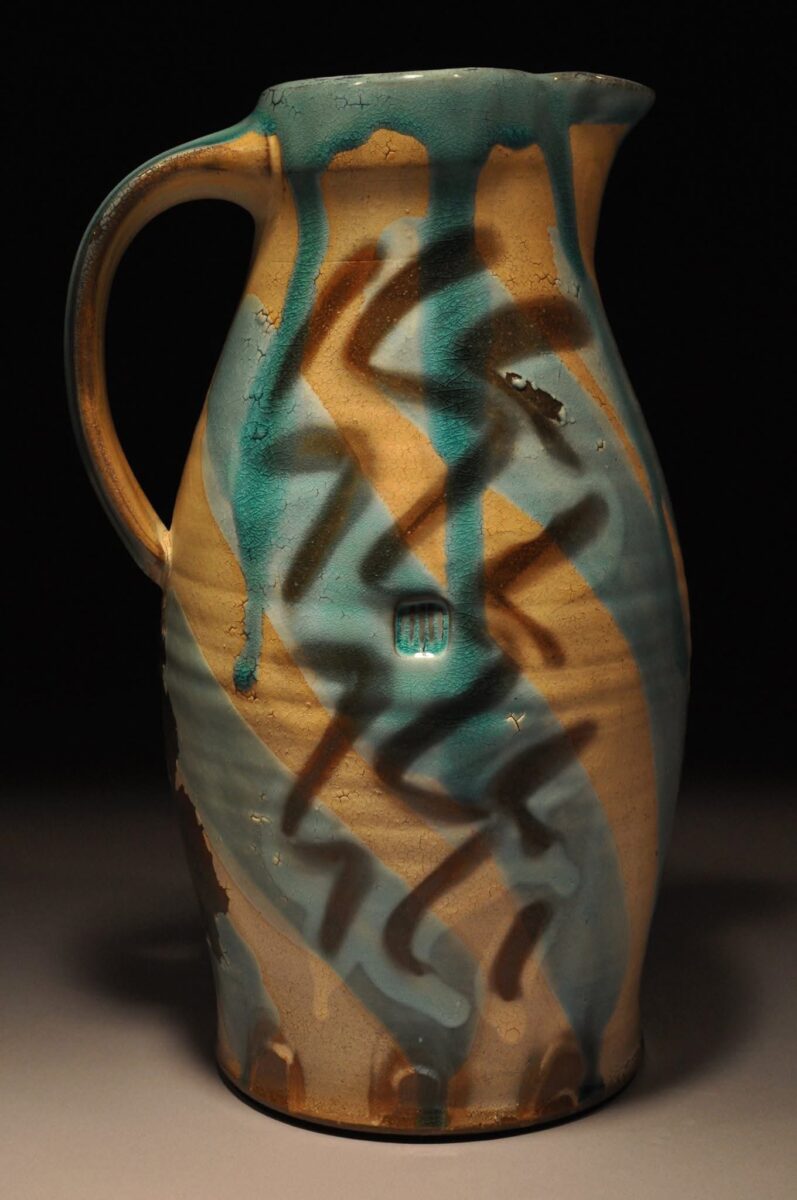
A ceramic tray’s bold chevron design is tempered by Jarvis’s decorative treatment of its corners, which echoes the angularity of its chevron.Jarvis created the loose zigzag strokes on this tall pitcher by applying a contrasting color of slip then running his finger across it while it was still wet, in a seeming reference to action painting.
Jarvis’s broad skill set plays a big part in his latest project, a joint artistic venture with Oliva. The couple sold their Charlottesville house going on three years ago and settled in the Shenandoah Valley’s historic Timber Ridge neighborhood, just north of Lexington. They live in what was once Goodman’s general store (the sign is still there), which served the adjacent, long-defunct postbellum Valley Railroad and its Timber Ridge train station. Behind their house is an old horse barn that they’ve restored and turned into a two-story workshop replete with five pottery wheels and a kiln. The Workshop at Timber Ridge, as they’ve dubbed it, now offers a variety of ceramics classes to the public, including raku firings. Jarvis will be adding a sixth wheel and bringing a second kiln online, and also plans to build a wood kiln. “We wanted studio space for ourselves that wasn’t just crammed into a corner,” he says. “But we also wanted to support other artists.”
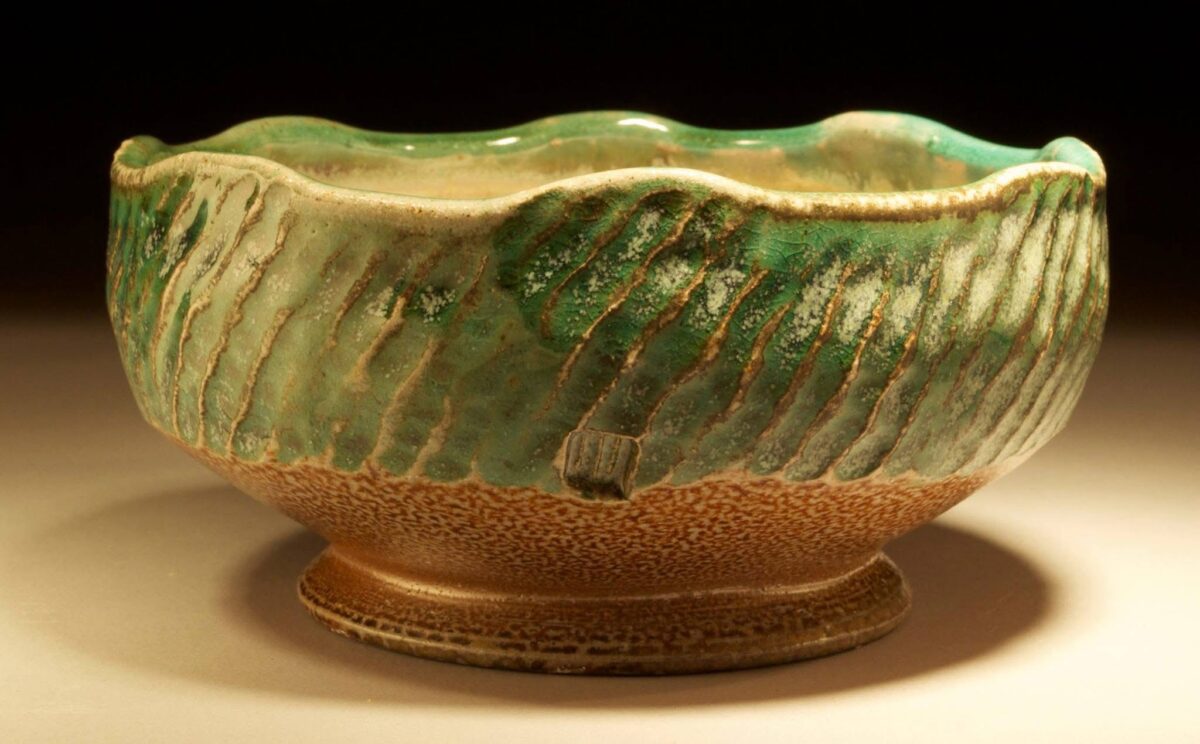
This green bowl with undulating lip features Jarvis’s trademark rope pattern, which is repeated by its rim.
Classes in other media are also on offer at the workshop, including drawing, painting, collage, and book arts, while summer art camps for both adults and children are upcoming, led by Oliva. A solid slate of photography classes includes botanical printing and alternative processes, including Oliva’s speciality, Polaroid transfers and emulsion lifts. The workshop has already hosted exhibitions and open houses, and Jarvis and Oliva plan to establish an artist’s residency. “The workshop is a work in progress,” Jarvis avers. “But it’s the getting there that’s important.”
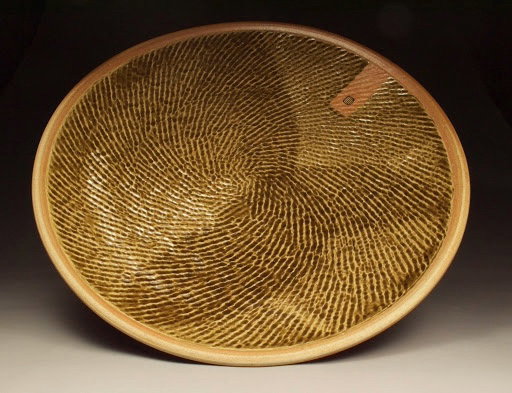
This large yellow/brown platter with fine rope pattern in the interior, upends the historical reference to basketry.
Russell Hart’s photography has been exhibited at the Boston Museum of Fine Arts and the DeCordova Museum in Lincoln, MA, among other museums. Photographs and drawings he made during a recent residency at the Virginia Center for Creative Arts were shown this June in the Smith Gallery at Charlottesville’s McGuffey Art Center. He currently teaches in the Master’s in digital photography program at New York’s School of Visual Arts, was formerly executive editor at American Photo magazine, and has won several awards for his writing about art.
Judd Jarvis is an artist living in Virginia’s Shenandoah Valley. Originally from Iowa, he received his BFA from the University of Miami and his MFA from the University of Nebraska-Lincoln. His primary medium since 1995 has been ceramics. Jarvis currently teaches ceramics classes, designs furniture, and creates functional and sculptural work out of the Lexington, Va. studio he shares with his wife, artist Cary Oliva. For more information about Jarvis’s work and The Workshop at Timber Ridge, visit jarvisceramics.com and theworkshopattimberridge.com.

 Russell Hart’s photography has been exhibited at the Boston Museum of Fine Arts and the DeCordova Museum in Lincoln, MA, among other museums. Photographs and drawings he made during a recent residency at the Virginia Center for Creative Arts were shown this June in the Smith Gallery at Charlottesville’s McGuffey Art Center. He currently teaches in the Master’s in digital photography program at New York’s School of Visual Arts, was formerly executive editor at American Photo magazine, and has won several awards for his writing about art.
 Judd Jarvis is an artist living in Virginia’s Shenandoah Valley. Originally from Iowa, he received his BFA from the University of Miami and his MFA from the University of Nebraska-Lincoln. His primary medium since 1995 has been ceramics. Jarvis currently teaches ceramics classes, designs furniture, and creates functional and sculptural work out of the Lexington, Va. studio he shares with his wife, artist Cary Oliva. For more information about Jarvis’s work and The Workshop at Timber Ridge, visit jarvisceramics.com and theworkshopattimberridge.com.