
OCTOBER
I awaken with a visceral heaviness, like dread, in my lower belly. My phone informs me it’s hours before dawn. Peering around the too-dark room, I remember: I’m in a rural Airbnb on a girls’ trip. I probably have food poisoning, I think grimly: it must have been the pizza.
Using my phone to see, I stumble to the bathroom and pee. When I stand up, bright red fills the bowl, spotted with black clots like planets in a solar system.
Last month I stopped using birth control after more than a decade. When on birth control, my period arrived on weekday afternoons like a familiar postman, and it certainly never felt like someone had stuffed a bowling ball into my uterus.
I clean up, find a tampon in my bag, and return to my room. As I step into bed, something from the floor sticks to my foot. It feels like a smooth kernel of plastic. I consider ignoring it—the surprise pool of blood has made me feel sullied and cantankerous—but after a second I stick my foot out of the sheets and brush the dirt onto the floor.
Illuminated by my phone, I stare at what almost went to bed with me: a thin black beetle, nearly an inch long, scurrying away from the light.
The unfamiliar room now seems full of scuttling things, the sheets greasy, my own hair on my neck making me twitch. Cramps wave through my abdomen like ripples through disturbed water.
NOVEMBER
We aren’t really trying yet, just letting things happen the way they will, we say to each other. But we also aren’t trying to stop it, not anymore.
My new feral period arrives the day before my husband and I leave for a camping trip to celebrate our anniversary. Thanks, new feral period.
DECEMBER
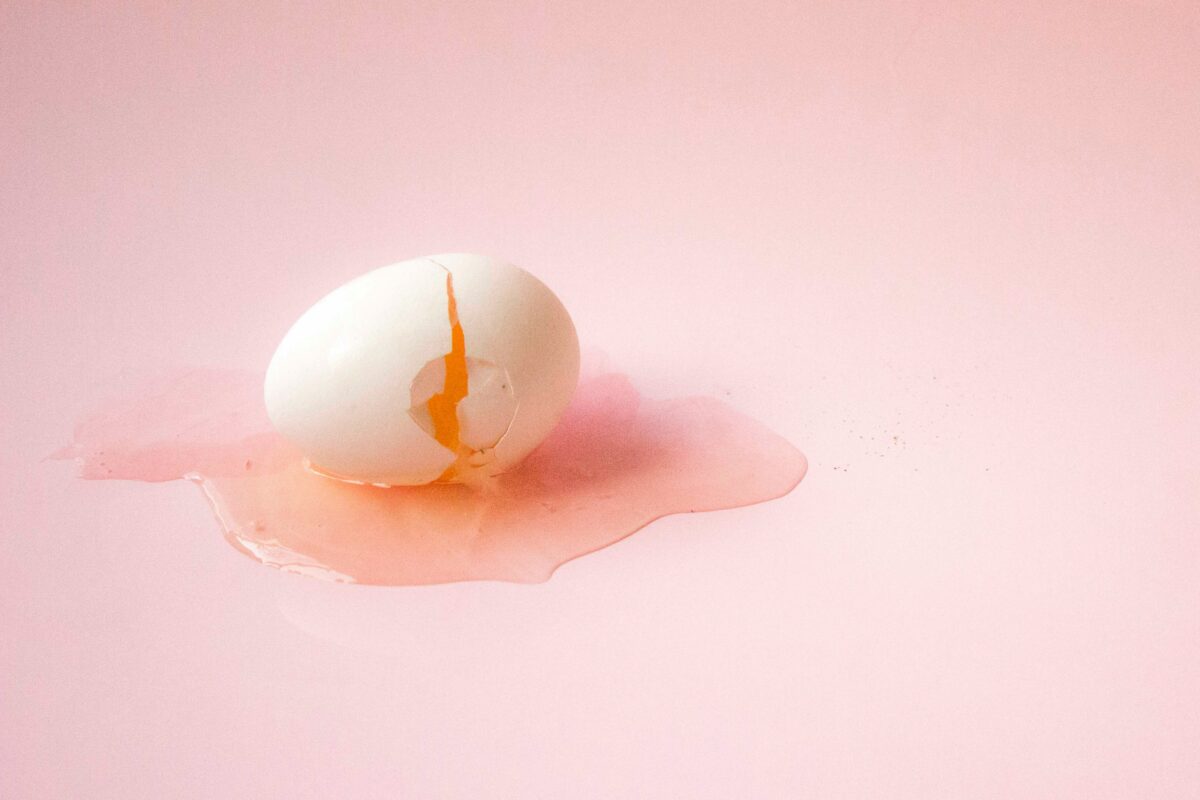
“I got my period which means another egg has been tossed off the wall,” I write in my journal. The rush of disappointment shocks me. After years of suppressing my fertility, I hadn’t expected to grieve the loss of a single egg.
My interest in motherhood is hard to explain when my friends and I discuss it: a gaggle of career-oriented millennial women shaking their heads and muttering to each other. I know having children can ruin your body, your finances, your career, and your relationship. There’s no guarantee my future offspring will give me high-quality care when I’m old. I’m not preoccupied with “legacy,” as if I were a Habsburg or something. I’m not concerned with passing on my genes, like a spiky-haired sci-fi denizen toiling to rebuild the human population.
When I think about why I want a baby, it’s more images than words. A downy head in the crook of my arm, the wide wondering of a baby’s eyes making all the spit-up and insomnia worth it. The experience of using my body to create in a new way, then to nurture, build, protect. Later, a person who might be like me and yet utterly unlike me, surprising and exhilarating; heartbreaking, possibly; fascinating, certainly.
When I think about having a baby, I think: I am going to love them so much.
JANUARY
While 80% of couples conceive in the first six months, some have to try for a year or more. “Ovulation typically occurs halfway through your cycle, so track the days,” the doctor says breezily. “It’s best to have sperm already in the cervix when the egg arrives.”
Many descriptions of conception imagine the sperm as the active party, latching onto the egg, but in actuality the egg engulfs the sperm, making it part of itself, until the two fuse into a zygote.
FEBRUARY
I have breakfast with my friend A., who recently got married, and she announces that she got pregnant on her honeymoon. A high-achieving worrywart like me, A. says she was also disappointed when on the first cycle they tried, she didn’t conceive.
But you have now, I say, you must be so happy.
“My sister is pregnant, too,” A. says. “She lives closer to my parents. I’m worried they’ll love my sister’s child more than mine.” She also battles nausea every afternoon for hours.
Each fear, resolved, merely sprouts into a forest of others, a Hydra of anxiety. I guess that’s what parenthood is like.
MARCH
Growing up, my primary lesson about sex was that doing it before marriage was a sin. The dire warnings of my teens seem unconnected to my current experience. The Mean Girls PE instructor shouting, “Don’t have sex, or you’ll get pregnant, AND DIE!” conditioned my entire generation. In reality, you can only get pregnant on a handful of days per month. Everyone who’s accidentally gotten pregnant must be stupid, I think, conveniently forgetting that I, at thirty-two, only just learned when ovulation occurs.
It has only been three months since we began trying. Still, I consider rushing back to the gynecologist and slamming my palms against the window.
“Don’t be stressed,” my fertility app admonishes. As if being stressed is a bubble on a test sheet, to be darkened or ignored.
APRIL
During a Saturday writing conference, an instructor tells us to free-write on the concept of liminal spaces. I don’t have to reach far: I stand between the smugness of my last achievement, grad school, and a hazy-edged next stage some consider an accomplishment and some a curse. I fear my body changing, yet crave it.
Conceiving is supposed to be a liminal space, but what if my husband and I get stuck there forever? I try to defamiliarize my own body by describing my stomach and pubis as if they are alien to my own senses. But instead, my body feels too familiar—I could not escape it if I wanted to.
The next morning, I go to a yoga class and a visibly pregnant woman unrolls her mat next to mine. She spends the class executing full splits and headstands, while I sweat and shake through a mere down dog.
My period is three days late. I buy a pregnancy test while picking up groceries. My husband lingers in the bedroom while I check the result. Not pregnant. “My body is taunting me,” I cry into his shoulder.
MAY
The doctor said little other than to try halfway through my cycle, but in a moment of frustration I take to the internet to learn whether there are other ways to know I’m ovulating. When I complain to my husband, a biologist, that the doctor never told us about ovulation strips, he says, “I assumed you already knew about them.”
All I had known was that to have sex without birth control is to instantly become a teen parent and guarantee yourself an unsuccessful life in the eyes of both capitalism and Christianity.
This month I am traveling for work during my fertile days, but I buy ovulation strips and test anyway to gather data. It is the beginning of a close monthslong relationship with my own pee. Over this and the subsequent months, I gather that my body ovulates later than in the average cycle, as many as two to three days past the halfway point. We have been trying too early. All those eggs waltzed out of me without being fertilized, despite all my (apparently bad) planning. How did the discarded eggs feel about this? Perhaps they were relieved not to fulfill their biological purpose. Perhaps they went on “Eat, Pray, Love” style walkabouts and found childless romance across the ocean.
I bitch and moan to my friend R. about how emotionally punishing it is to try for a baby. I then admit I’ve been working with faulty data. And that even if we had been trying during the right days, we’re still within the average amount of time it takes to get pregnant.
“I wanted it to be easy,” I say.
“You’ve always been this way,” R. says. “You’re trying to get an A in something that’s not even graded.”
JUNE
Early pregnancy often has the same symptoms as premenstrual syndrome. Backache, tender breasts, bloody spotting: my fertility app is eager to inform me that all these things either mean I am definitely pregnant, or I am definitely not. I grow to loathe its obsequious little tips (“Seeing spotting? Could that be you, implantation bleeding?” “Sore boobs, mama? This might mean pregnancy!”). Every tiny signal from my body is a flag raised, every bit of discharge in my underpants worth recording. I feel like a toddler, like I might eat my own boogers next.
Despite the monthly disappointment, going off birth control has been empowering in a way I didn’t expect. I read about my follicular and luteal phases, plan activities for days in my cycle when I expect to have more energy, and learn to be gentle with myself as my body descends into the menstrual phase, that heavy downward clench.
My moods and inclinations aren’t dictated by some moral failing, but by a spout of hormones abruptly turned full blast every month. Guided by the moon, like a wild creature in mating season, like the incoming tide. The understanding gives me a power I haven’t held before—one I certainly never learned in sex ed or church. It gives me compassion for myself when I need it most.
JULY
We complete the second of two beach trips with my family. (Competing summer vacations: a hallmark of divorced parents.) I find something titillating about trying to have sex in silence. It’s not that my family is on the other side of the wall; if I think about that, I’ll instantly become the Mojave. Rather, it’s the clenched-mouth stakes, my husband’s hand over my mouth, the unfamiliar bed.
AUGUST
I see a gynecologist other than Dr. “Didn’t Tell Me About Ovulation Strips.” The new doc tells me to take more vitamins: in addition to a prenatal, I should be taking a women’s everyday multivitamin, magnesium, and coenzyme Q10. My husband should also be taking magnesium—for sperm health and vigor—and we should have sex every other day during the fertile period, not every day, because if we have sex every day, the quality of sperm declines. I feel like I’m assembling a mad evidence board covered with red thread: track the days, pee on strips, swallow pills, and do not let that jizz quality decline!
Said husband has begun eyeing me with trepidation when I tell him ovulation is coming soon. Oddly enough, the mad evidence board of fertility maximization doesn’t make for a sexy atmosphere. Sometimes he says, “I just can’t today.”
We move into a new house, and it feels like the unpacking will never end. During a family visit intended to help us set up the house, my period arrives. I stop helping my in-laws clean and lie on the couch, staring into space. Feeling sorry for myself alone is preferable to suffering an inundation of unhelpful advice and soggy pity. I wish everyone would leave. I even wish I would leave.
SEPTEMBER
Is this what it was like to be a queen in the 1500s, under intense pressure to conceive the next ruler of England? Is this how Anne Boleyn felt? What I’m enduring must feel exactly like attempting to conceive a male child with a rotting, infertile king, then getting my head chopped off after being accused of adultery and incest.
OCTOBER
I finish revisions on the novel I’ve been writing for years. Instead of the surge of celebration I expected, I feel like a Jack-o-lantern with no candle inside. I thought I’d be rushing to finish these revisions as my belly grew. Or that I’d even have a baby by now, reveling in the all-encompassing love and sleeplessness of those first months.
For the first Halloween in our new house, we buy bags and bags of candy from Costco, convinced hundreds of trick-or-treaters will knock on our door. Instead only a dozen show up. The extra candy gleams on the floor of our basement in a dazzle of colors and plastic. “I guess I’ll take it to work,” my husband says.
NOVEMBER
We fly to Aruba for our anniversary. The last time we were here, we scuba dived and saw eels, turtles, and shipwrecks wreathed with coral as we breathed fifty feet below the surface. This time, I might be pregnant, so my husband dives while I read on the beach and try to write. My period arrives while he is diving. I imagine descending at the start of a dive, how the wondrous surrounds are only the beginning—a feeling I have missed out on, all for nothing. My husband returns to find me several mojitos deep.
I decide I’ll return to the doctor in January and arrange for fertility testing. I’m loath to schedule the appointments; it feels like admitting something I hoped never to have to admit.
DECEMBER
When you’re trying to conceive, your heart cracks on a monthly schedule. Each cycle spiders into a hairline fracture: surely this time won’t shatter it, surely it will hold through one more go.
A couple of weeks after Thanksgiving, we visit Luray Caverns and marvel at the stalactites and stalagmites, the still, reflective water, the rhythmic drips that built a patient masterpiece beneath the mountains. My period is late again; jaded, I quash any hope. My cycle is a mercurial trickster, a wily minx.
The next day I visit my friend A., the one who got pregnant on her honeymoon. She’s tired, irked at her husband, recently recovered from mastitis; yet her eyes melt with warmth when she hands her baby to me. He has sage-green eyes and wriggles in my lap like a tiny kraken.
For years I’ve wondered whether I only want to become a parent because I’ve been conditioned to want it; whether giving birth will tear my body and leave behind a mess of stretch marks and stitches; whether motherhood will erase my writing and thinking and cursing and drinking self and subsume me into a new role. But after a year of hopes rising and receding like tides, a year of obsession and tears, I am ready to be subsumed. Motherhood is something I want, and I’ve shown myself how badly I want it. The gift of this year is certainty.
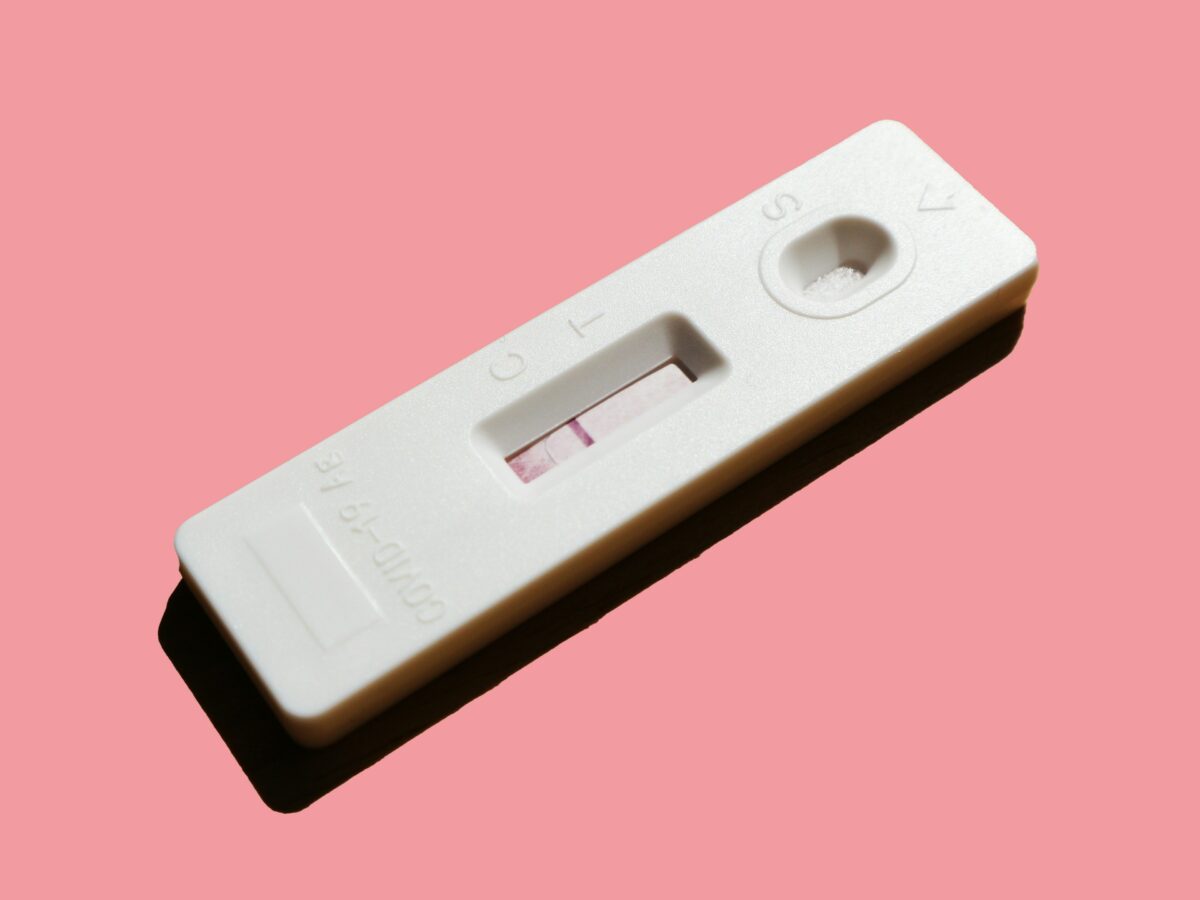
I take a pregnancy test. (No amount of poetic language or emotional angst can eclipse the fact that this has been The Year of Peeing on Sticks.) My whole body feels like a beating heart. Is that a positive line, indicating the presence of human chorionic gonadotropin, the hormone only produced by a pregnant body? If it’s a line, it’s so faint it seems to fade into and out of existence, like a star only visible from the corner of your eye. My husband and I agree it’s too faint to be conclusive. The fertility app recommends I wait two days, then test again.
I work from home the next day, Monday, not thinking about it. Of course I’m fucking thinking about it. On the second morning, I pee on another stick, set it on a wet wipe on the counter, and wait the prescribed two minutes, my eyes averted. Waiting for the next direction my life will take, waiting, waiting.





Share this post with your friends.

