
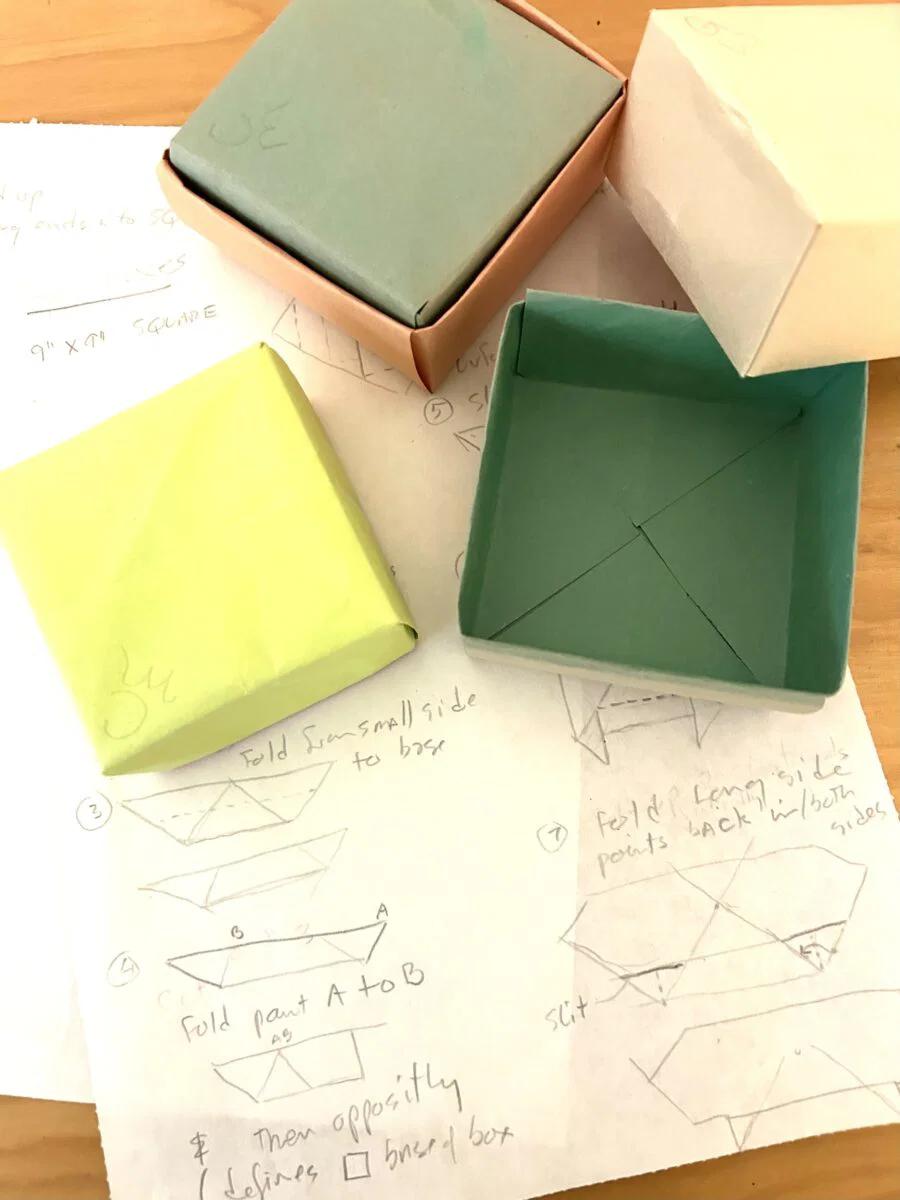
While cleaning out our storage room of old magazines, financial records that might should be in a safe deposit box, worn out bed sheets, and a fifty-year accumulation of the miscellaneous, I found several small paper boxes that our grandchildren had made when in middle school. They were products of a three or four week fad among their friends. They represent a wonderful example of learning by observing, by doing. This method is the fundamental way of accruing knowledge: I am speaking of an intimate relationship between human teacher and the student learner. Those same grandchildren are now pursuing post-graduate education via online courses!
Briefly, these boxes were made by folding and slitting two square pieces of craft or construction paper: one tray for the bottom and one for the top. I was reminded that years ago, I had come across a book on traditional Japanese containers and that I was fascinated by the variety of materials used and the dedicated purpose of many of them. (I think it was titled How to Wrap Five Eggs: Traditional Japanese Packaging by Hideyuki Oka). This remembrance provoked my curiosity as to how these paper boxes were constructed. I wanted to discover the kids’ cleverness.
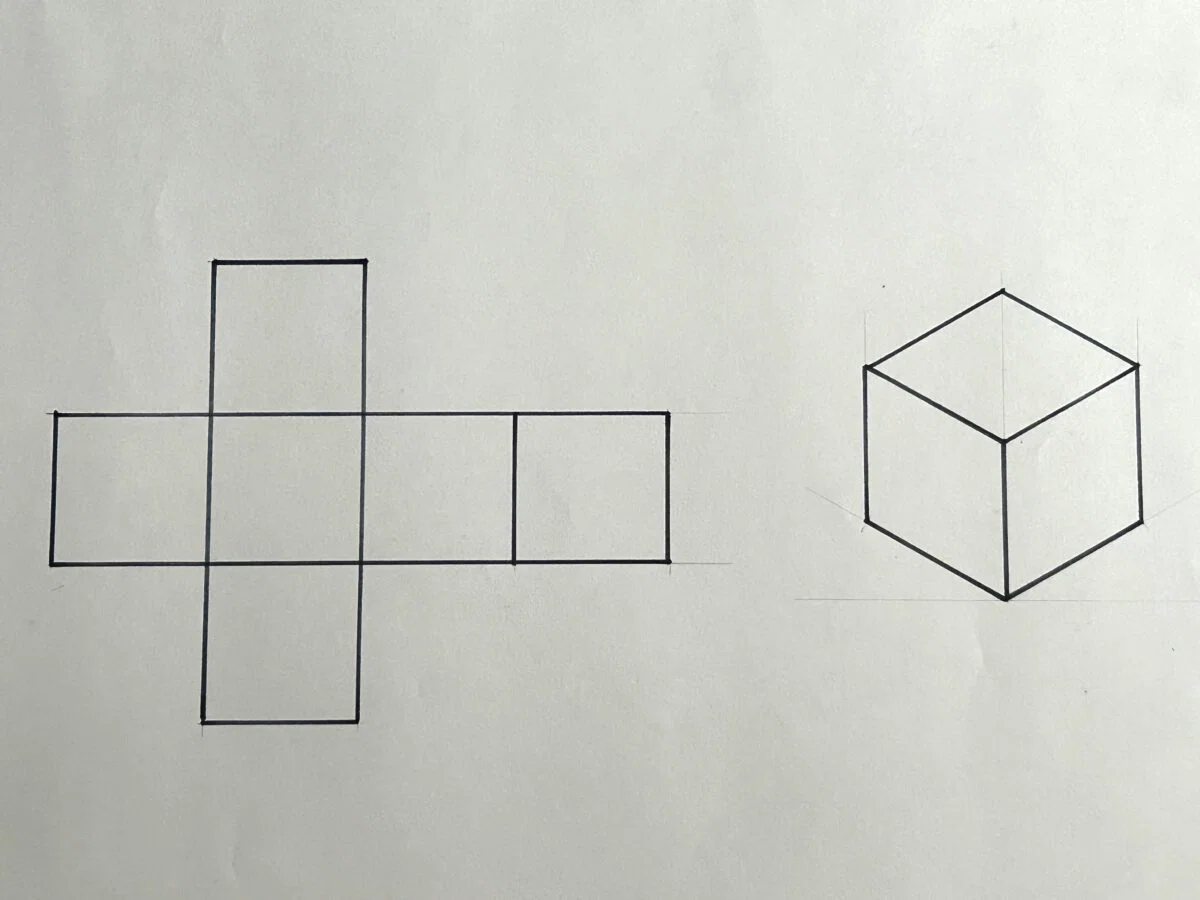
These boxes are not so intricate or as artistic as the origami boxes I remembered from the book, but they also reminded me of those visual reasoning questions of aptitude tests taken when I was an adolescent. In one part of the test, a ‘flat’ representation of geometric planes was to be visualized and mentally folded into a geometric solid. From four choices I had to select the correct end result. The drawing below is such an exercise for a cube.
These boxes had sides sturdy enough to be gift boxes for earrings made from Roman coins, or a ceramic figurine of an elephant or for a pet rock (also a fad around that time), measuring 3 1/8” X 3 1/8” with 1 1/2” high sides: essentially, two shallow trays nearly identical so that one fits over the over. I methodically unfolded one tray, making a diagram for each unfold and when appropriate, each slit. This process generated a SXS (step by step) how-to in reverse. Through ten separate operations, most having symmetrically paired folds, I ended up with a square piece of paper (9’ X 9”) with four slits.
The phrase reverse engineering can be broadly applied to any deconstruction of a finished product, system, or (contemporarily speaking) software to discover how it works, how it was built, or what components it contains. Reasons for doing this are based on the fact that the product doesn’t function (like a broken appliance) or is defective in design (‘frogging’—“rip-it, rip-it”—a knitting because of faulty stitch counting or use of the wrong sized needles,) or perhaps to solve a social problem whose cause needs to be determined and analyzed. (Why can’t society adequately address homelessness, for example?)
This process is not regressive as there is no desire to return to the good ole days, but like archaeologists, we are curious about the past with the intention to better understand and appreciate the present and possibly steer society toward a better future outcome. (David Byrne’s book, Sleeping Beauty: How Good Ideas Go Dormant and How They Wake Up may touch on this idea though I confess I have not yet read it.) I would argue that there is a great need these days to adopt a ‘back-to-basics’ approach. Some years ago, this was an educational mantra. As technology continues to make our lives more complex, our lives become more stressful, distracted, less manageable. Great men are those humbled by simple wonders.
It seems that after any accident, mass shooting, major shift in governmental policy, or after a natural disaster, there is a government commission established to “make sure it never happens again.” Of course, human events are made up of repetitions and, not to be overly cynical, the cycles of causal events rarely vary from the basic characteristics of human nature: that nothing is permanent, but everything is unsatisfactory.
Henry David Thoreau advised us to simplify our lives: “Our life is frittered away by detail. An honest man has hardly need to count more than his ten fingers, or in extreme cases he may add his ten toes, and lump the rest.” [Walden Chapter 2] That is to reverse engineer one’s life and in so doing discover the essential thoughts of importance, ridding ourselves of distraction, frivolous activity, injurious gossip, and of asking questions that don’t address the essential problems of life.
The perfect gift is a handmade giftbox. If not literally, it contains the gift of one’s effort, one’s kindness. To test my reverse engineered box directions, I got out paper and scissors and made these treasure boxes. I appreciated the care and precision (and patience) those kids took to produce their boxes. I put a short poem into each for my grandchildren. No special occasion, just what grandparents do.


Follow us!



Share this post with your friends.

