Why I Loved the 8-Track by Karen Weyant

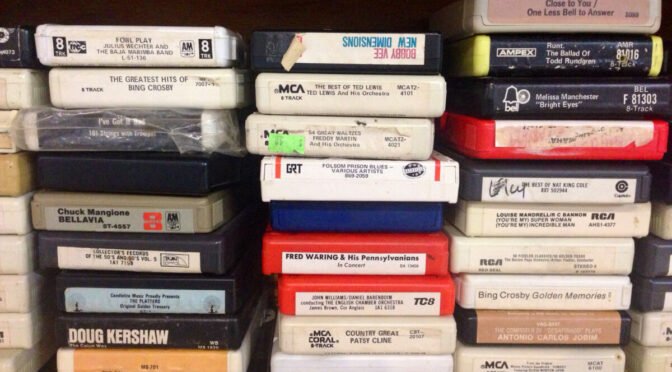
Photo of stacks of 8-track tapes
 

Today, we stream any song we can find, google obscure one-hit wonders, and watch anyone make their own music videos on TikTok, but back before they were delegated as punch lines to jokes about music history, we loved our 8-track tapes. The 8-track tape, a magnetic tape sound recording device enclosed in a plastic container, was popular from the late 1960s until the early 1980s. Although the quality of the sound was problematic, the protective casing was rather sturdy. Plus, 8-track tapes had the added bonus of continuous play, unlike their counterpart, the cassette, that … Continue reading Why I Loved the 8-Track by Karen Weyant

The Bus Was Late: a Stamford Memory by Jeffrey Coughter

Photo of five school buses side by side
 

Jeffrey Coughter has earned an Honorable Mention in Streetlight’s 2023 Essay/Memoir Contest   On a sunny, breezy late October morning in 1959, I was among a handful of kindergartners waiting for a school bus near the front stoop of Boucher’s, a restaurant at the corner of Long Ridge Road and Stark Place in Stamford, Conn. The bus was late, but we didn’t know how late. We were all five, or nearly five years old, and “time,” when you’re five is not quite the same as when you’re sixty-five. We waited that crisp, autumn morning, as … Continue reading The Bus Was Late: a Stamford Memory by Jeffrey Coughter

Waterfall by Jo Riglar

Photo of waterfall with rainbow through it
 

  Jo Riglar is the 3rd place winner of Streetlight‘s Flash Fiction Contest I reached the waterfall as the rain started. Little vicious drops. A breeze bothered the trees. An angry dog in the distance. I rested on a flat rock, no moss, but cold and damp under my thighs. A summer sun was thwarted in its mission by the grey of the clouds. When I was a child I used to chase clouds, sat in a light chair and raising my face in worship. I remembered that now. It was a hopeless enterprise. ‘Nice day … Continue reading Waterfall by Jo Riglar

Call of the Wild by Trudy Hale

Photo of bear cub on tree limb
 

I wanted to write about hunting season here in the rural countryside, the howling packs of dogs, the men and women who sit in muddy trucks on the side of the road with loaded guns, waiting, and the orphaned black bear cubs. I also wanted to write about my Mississippi cousin who transported cross-country in the back of his Toyota pickup, a taxidermied bear’s head bagged on a Native American reservation in New Mexico. But October calls me, like the wild and wild things, to write about my wild nephew. He will be turning twenty … Continue reading Call of the Wild by Trudy Hale

17 Year Cicada by David B. Prather

translucent green wing
 

  —Magicicada septendecim I never thought I could love you, arguing with leaves under midday sun, your body a prune with polymer wings that look like they might shatter at a touch. When my father told my mother he was in love with another woman, everything breakable flew off shelves, shook loose from frames, fell free from cupboards. I was breathless, my lungs heavy with humidity, a death rattle shaking in my throat, which reminds me of you, your song a pall through afternoon and on into evening. If only I’d known your name was … Continue reading 17 Year Cicada by David B. Prather

Sinking by Deborah Prum

Photo of hands sticking up through water
Photo by Blake Cheek on Unsplash

I attended a state university that required you to pass a swim test to graduate. I will not mention the name of the institution because I’m about to malign them.

When the orientation materials arrived by snail mail, included in the package was an inquiry about whether I could swim. I could not swim. The thought of getting into a pool terrified me. I grew up in a city apartment surrounded by a sea of asphalt and concrete. We had no access to water for recreational purposes, not even a leaky fire hydrant. As a child, I did not swim laps at the neighborhood pool. As a child, I got my exercise running away from my combative companions at Smalley Elementary School.

I crafted a vague response to that swimming form which I hoped would lead them to believe I could swim. I assumed they’d take me at my word; to be precise, take me at my ambiguous words.

When I arrived at orientation, I received an invitation to come at the gym for swim test. The letter had a Mafia-like tone to it, succinctly stating that this was an offer I could not refuse.

On the way to the gym, I engaged in magical thinking: Dogs can doggy paddle, right? Who teaches them? Nobody. I am smarter than a dog. Certainly, I can doggy paddle if I try hard enough.

About fifty women stood shivering in a line around the perimeter of the pool. That autumn morning, the maintenance folks must have thrown ice in the water especially for us. An older woman stood next to the diving board, clipboard in hand. She wore a white polo shirt and a gym skirt, which irritated me no end. Why wasn’t she in a bathing suit? She should be prepared for all emergencies.

I stood about tenth in line. The first nine girls walked down the diving board, dove in, then swam across the pool. Clearly, they hadn’t lied on their swimming form.

As I reached the end of the gang plank, my knees began to buckle. Who was I kidding?

I yelled, “I can’t swim. Don’t make me!”

That gym teacher did not care. Not one bit. The forty freezing women standing behind me also did not care. They shouted, “JUMP!”

I jumped and sank to the bottom. Even dead bodies float, but my bones must be made of lead. The instructor took her sweet time pulling me out.

Feeling wobbly, I staggered to the locker room where I saw a bright burst of light in the left corner of my vision, then passed out. Over the months, I passed out more times. A doctor determined my problem likely stemmed from the many head injuries I’d sustained as a child, due to both my ill-advised risk taking (another story) and my combative schoolmates.

You may wonder how the university responded. They didn’t say, “Bless your heart, child, we are sorry you’ve been through so much. Take a relaxing poetry course. On us.”

Instead, they grudgingly waived the swimming requirement and forced me, the shortest person in the entering class, to take fencing with a horde of tall, aggressively wild women who spent a semester in a tiny room chasing me around with large fake swords. That’s why I see a therapist to this day.

The moral of this story?

I agree with Walter Scott who said, “Oh, what a tangled web we weave . . . when first we practice to deceive.”


Deborah Prum

Deborah Prum’s non-fiction has appeared in The Washington Post, Southern Living and Ladies’ Home Journal, and Huffington Post. Her fiction has appeared in The Virginia Quarterly Review, Across the Margin, McQueen’s Quinterly, The Virginia Writers Centennial Anthology, Sweetbay, and Streetlight Magazine. You can read her fiction and non-fiction writing at https://www.deborahprum.com/my-writing.html. Prum’s radio essays have aired on NPR-member stations; here is an example of one. If you would like to hear a recording of SINKING, check out Prum’s blog at https://deborahprum.com/blog/.

Deborah Prum’s articles on writing have appeared in The Writer, The Writer’s Handbook, and the Society of Children’s Book Writers and Illustrators Bulletin. She works as a developmental editor and teaches at WriterHouse in Charlottesville, Va.

Follow us!
Facebooktwitterinstagram

The Bridge of Sighs by Martha Wiseman

Martha Wiseman has earned an Honorable Mention in Streetlight’s 2023 Essay/Memoir Contest


My mother sighed. Frequently, variously, operatically. She was, after all, a singer, a dramatic soprano.I can barely sing. But I can sigh. All my life I’ve apparently been practicing my mother’s repertoire of sighs. A teacher once told me I sighed more than anyone she’d ever met. She never met my mother.

***

My mother sighed when faced with something she’d prefer not to do (and she preferred not to do a great many things). She sighed when I became, as she might say, obstreperous. She sighed when thinking of her own history. Some of the arias she practiced sounded like sighs to me.

Close up photo of frowning Lego woman with viking hat, long braided hair, and sword
Lego Opera Singer-not happy by Ted Drake. CC license.

Let me catalogue her repertoire. Some sighs began with deep, long inhalations, as if she were sucking in air, the exhalations like descending arpeggios, a soul sinking down. Some entailed a rapid series of brief inhales followed by an extended sequence of outpuffs. Some involved a slow intake of air leading up to a heart-rending moan of Oh, God. Late in the evening, as she settled herself in bed—perhaps with her copy of The Food of Italy—the sighs ranged from melodic to labored and stuttered, an unmistakable song cycle, a summary of another melancholy day, her version, I like to think, of vespers.

***

My mother adored things Italian. She’d lived in Italy, studying opera, the year before I was born. I don’t think she lived in Venice. But perhaps she visited that watery city and crossed the Bridge of Sighs. My mother’s name was Nell, but she preferred to be addressed as Nella.

***

I’ve read that these days, one can enter the Bridge of Sighs only as part of a tour, and only in summer. As the bridge is enclosed and its windows barred, visitors may become overheated and claustrophobic. One would, I suppose, if one were headed to the prison on one side of the bridge.

Ah! Sospiro!

***

My mother may at one time have been in love with a tall Italian man named Gernando. She referred to him as a friend. At some point, I realized I hadn’t heard her mention him in a long time. I asked about him. Her face clouded and she sighed almost angrily and said she never wanted to hear his name again. I could glean only that they’d planned to celebrate New Year’s Eve together and he did not show up and soon married—married someone else, I supposed she meant. My mother never forgave him.

***

I’ve never been to Italy. But if I ever go to Venice, perhaps I’ll walk on the Bridge of Sighs and heave a good sigh for my mother.

***

My mother, despite her Italian leanings, did not like Puccini. I find that I don’t much, either. She loved Mozart, as do I, and he was Austrian. The libretti for most of his operas, however, were in Italian. She found Beethoven too Germanic. But she sang Hugo Wolf, and she was partial to Richard Strauss.

After my mother died, I found a picture postcard of Venice’s iconic opera house, La Fenice, among the few mementos she’d kept.

***

I don’t think my mother knew that Byron’s “Childe Harold” (he just goes on and on, she might have said) is credited with making the bridge famous:

I stood in Venice, on the Bridge of Sighs,
A palace and a prison on each hand:
I saw from out the wave her structures rise
As from the stroke of the enchanter’s wand . . .

The legends attached to the Bridge of Sighs—that convicts crossing over from interrogation in the Doge’s Palace to their place of confinement sighed their last sigh of freedom on this bridge or sighed at their last view of the city; that lovers passing beneath the bridge were guaranteed a never-ending amore, their sighs of contentment breathed upward—are just that, legends, the one historically impossible, the other wishful.

Maybe my mother slid under the Bridge of Sighs in a gondola. Was she with anyone besides the gondolier? Her own wishful thinking—her longing for lasting love, for an operatic life—would have led her to sigh dramatically, trailing her hand through the polluted water.

When she lived in Italy, she was married to my father, but he was not with her. She said she came home because she wanted to have me before she was too old. That wish was fulfilled, at least. The lasting love vanished.

Photo of the bridge of sighs from the water
The Bridge of Sighs by helicon two (flickr.com). CC license.

***

I sigh. The sighs are my mother’s legacy. A bridge between us. Perhaps that is overly symbolic, but the metaphor seems fitting. Straightforward, which our relationship wasn’t.

Sometimes simplicity and straightforwardness are reassuring.

***

I hear myself taking a deep, almost gulping breath. I hear the rough, sorrowful exhalation that follows.

I hear my mother.


Martha G. Wiseman
Martha Graham Wiseman has been an acting student, a dancer, and an editor. She taught English at Skidmore College in Saratoga Springs, N.Y., until retiring in 2020. Her essays have appeared in The Georgia Review, Fish Anthology 2021, Ponder Review, Dorothy Parker’s Ashes, Under the Sun, The Santa Ana River Review, The Bookends Review, oranges journal (U.K.), Kestrel, and Map Literary; work is forthcoming from Queen’s Quarterly (Canada). She has also published fiction and poetry.

Follow us!
Facebooktwitterinstagram

In the Nature of Chickens, There is Little Room for Gentleness by Emma Fenton

Two chickens, blue building, overgrown chickenyard, rustic look
 

On Thursday, there are three chickens in the backyard pecking at each other, plucked feathers scattered on the ground like a gruesome crime scene. You could make a fourth chicken out of this, I think and rescue the yellow one with a bleeding wing. She scrambles in my arms, talons clawing at exposed flesh. I drop her. She returns to pecking, happier in the violence which is more comfortable to her than in my arms: safe but unknown. I do not know how to save them if they do not want to be saved, only … Continue reading In the Nature of Chickens, There is Little Room for Gentleness by Emma Fenton

The Thrill of the Sale by Emily Littlewood

Photo of woman throwing hands in air while looking at computer
 

Recently I was able to convince my husband to let go of a small part of his hoard/collectibles (vocab depending on who you ask). This was accomplished with the promise of selling the things, which was both a great triumph and a self-imposed curse. As the more computer literate of the two of us, it fell on my shoulders to post on eBay. In theory eBay is great. Someone a few miles away or across the world could want what you’ve got. Unfortunately if I haven’t done it in a while, I forget that the … Continue reading The Thrill of the Sale by Emily Littlewood

grown girl: she thinks of the dead by Liz Femi

Photo of alley between brick buildings with graffiti
 

it surely is the same wrinkled sky from years ago when i lived in dense forest towns when cold winds chafed Iroko bark like prayers chafe fingers. i smoothed my first grinding stone with rocks rocks picked from streets maddened from stoning thieves. i peered down wells and called to the nameless to find out for myself: guards of the wide road where mothers have gone mad where faint rhymes tuck into palms, love poems in vapors, breastmilk curdles with ghosts, and from mounds poured for the forgotten, i walked, anyhow, anyhow myself Liz Femi … Continue reading grown girl: she thinks of the dead by Liz Femi

Streetlight Magazine is the non-profit home for unpublished fiction, poetry, essays, and art that inspires. Submit your work today!