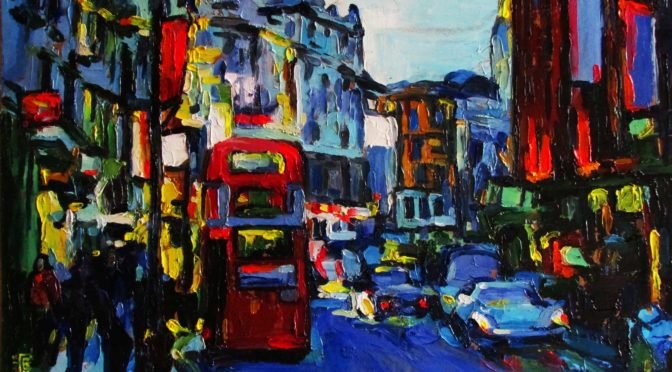
Images come in my imagination, either imposed by impressions from the movies, music or theater or by simple communication with another person. Some think my works are based on literature, but this is not so. The image of a potential picture will not leave my imagination until it is depicted on canvas or paper, an oil or acrylic painting. First, I inwardly develop all the details. Sometimes I start a small sketch, but the more detailed image is developed in my mind, the less time and effort I need for its implementation. The … Continue reading Imaginings by Kateryna Bortsova→
A while ago I went with one of my nieces to get matching semicolon tattoos. This was remarkable for a variety of reasons: 1. I was 56. 2. Years before, when my eldest daughter came home from college sporting her first permanent ink, I may not have reacted well. 3. Trends in general have always bugged me. A lot. Our landfills are filled with them. So are our photo albums. 4. In terms of the grammar symbol itself, I never really got semicolons. Half comma, half period—what is that about? (Kurt Vonnegut rudely referred to … Continue reading The Semicolon, Another Grammar Guidepost by Erika Raskin→
“Period. New Paragraph,” the mother of a good friend of mine used to announce when changing subjects—sometimes mid-sentence. It’s a good rule for life in general, though. I believe in changing your mind. When I was in sixth grade I agreed to participate in an Outward Bound type field trip that involved rappelling down a cliff. I took one look at the ground below and sat on the grass. Period. New Paragraph I spent freshman year of college in a state so cold that by November when I went outside with wet hair, it froze … Continue reading A Grammar Rule to Live By by Erika Raskin→
I’ve lived way out in the country for a little over a year and, with the exception of an inability to have food delivered, I have no complaints. There is something weird about the house though: the rocks. The previous owner used them to mark the driveway to separate it from the yard. But he didn’t stop there. He went on to create a path outlining the entire acre. He also used them to encircle the trees in the yard. Every. Single. Tree. We live in the George Washington National Forest. This is something that … Continue reading Beauty is in the Eye of the Boulder by Emily Littlewood→
Maida Westabrook was a brave little girl who had a “floating mass of hair, pale gold and tendrilly” and also a serious chronic illness, which had at one time confined her to a wheelchair, but that was in the past. She could now walk, albeit with difficulty, and had many friends. She also had a devoted—and, happily, wealthy—father, a widower who cherished the life of this his only progeny and thus was devoted to making her life satisfying, stimulating, and worthwhile. To that end, as can happen only in fiction, he provided her (in a … Continue reading Maida’s Little Books by Susan Shafarzek→
The heavy, punishing rains have stopped for now, and I step out onto the sun-warmed deck facing our back yard. A third of the space is now a lake, and in the center of this six-inch deep water stand our bird feeders. One with a metal green box perched on a steel pole is full of basic mix composed of sunflower seeds, millet, yellow maize chips. The others hang eight feet away offering sunflower seeds, and suet. Tufted titmice, cardinals, sparrows, nuthatches, and the persistent chickadees are busy at each feeder. A blue jay swoops … Continue reading The Birds of Spring by Roselyn Elliott→
As a retired college English professor, I much enjoy editing manuscripts part-time. Clients find me via a University of Virginia website called Professors as Writers, a service intended for UVA faculty and grad students seeking help with their writing. The service is also available to anyone else accessing the site. About five years ago, I received a call from a Nigerian man who lives in Virginia, teaches full time at a university, and had just finished drafting a book manuscript that was a defense of God and Christianity. I accept only editing jobs that intrigue … Continue reading Editing as Channeling: A Dangerous, Necessary Evil? by Dick Harrington→
Being disowned by your family is often an integral part of the queer experience. It’s a common story that I find is meticulously avoided in popular, escapist/pulp media—an effect of heterosexism that erases and denies the reality of gay lives: “No kween, make us laugh!” Sometimes I wonder how different my life would be if my father and mother had disowned me. It would be revealing to watch a movie of my life without my father’s influence—a twisted version of It’s a Wonderful Life. My family didn’t disown me. However, they also have never been … Continue reading Placeholder Son by Spriggan Radfae→
One evening, damp and full of anguish, I arrive at a camp and basically fall apart. I want to talk to my boyfriend back home, but as usual have no signal. I start climbing on soggy leaves, moving higher, hoping. Finally, a few circles fill in on my screen and I call. His voice is like a hug, but as soon as we start speaking the raindrops start up again. Reluctantly I let him go and trudge downhill to the shelter, set up for the night. In an iPhone advertisement from when FaceTime was new, … Continue reading A Dream To Disconnect, by Mathina Calliope→
Write what you know. That was the mantra when I was in graduate creative writing school. We were admonished to write from our own experience, not to try to reach beyond our boundaries and try to re-create worlds about which we had no real knowledge and which would, thusly, come across as fake. But like all mantras, this one has its limits. For instance, my first book, The Algebra of Snow, is about a mathematician alone in the Adirondacks in winter. Anyone being less mathematical than I would be hard to imagine—I struggle with addition. … Continue reading In Praise of Not-Knowing by Ginger Moran→
Streetlight Magazine is the non-profit home for unpublished fiction, poetry, essays, and art that inspires. Submit your work today!